
Imagine meeting someone who feels strangely known
Imagine Maria meeting Daniel at a friend's dinner. They have never spoken before, yet the first hour feels oddly easy. He remembers a detail she mentioned once. She understands the joke he makes before anyone else does. They talk until the restaurant closes, then keep talking outside in the cold. On the train home, Maria doesn't think, "I met a stranger." She thinks, "Where have I known him before?"
The feeling matters. So does the question that follows it. A familiar connection can be a real meeting of emotional styles, values, and attention. It can also be a rush of projection, timing, desire, or recognition of a pattern you've carried for years. Often, it is several of these at once. The mistake is not feeling too much. The mistake is asking the feeling to prove more than it can prove.
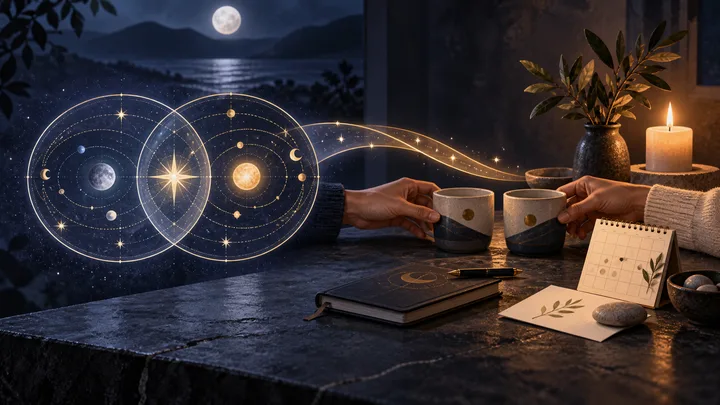
Synastry gives astrologers a language for this first impression. It compares two natal charts and studies how one person's planets and points touch the other person's. The Moon can show a sense of emotional ease. Venus can bring affection and pleasure. Sun-Moon contacts can create an instinctive feeling that each person understands the other's inner and outer life. Saturn can make the bond feel serious, binding, or familiar in a quieter way. The lunar nodes may add a sense of meaning or unfinished movement, depending on the tradition and the astrologer's method.
None of that creates a shared past in the practical sense. You still have to make one. A connection becomes a relationship through repeated choices: showing up, telling the truth, making room, keeping promises, and returning after strain. That is the thread this article follows. What does the familiarity mean, and what would let it last?
The question becomes especially tender when the connection is not yet defined. You may not know whether to call it friendship, romance, spiritual kinship, or a meeting that changes you and then moves on. You don't have to choose the grandest label first. Notice what the meeting asks of you. Does it invite you to be more honest? Does it make you more present in your own life? Or does it pull you into waiting for a sign that the other person has not given?
You can hold wonder and discernment in the same hand. Wonder says the meeting deserves attention. Discernment says the person deserves to be known, not imagined. Together they let you stay open without becoming careless. That is the right beginning for a connection that feels familiar but has not yet earned the name of a shared life.
There is dignity in letting a connection remain a question for a while. You can enjoy the meeting, protect your pace, and stay available to what is true. Mystery doesn't require you to abandon your standards. Patience gives the feeling room to become specific. You learn whether you miss the person, the possibility, or the version of yourself that appeared beside them. That knowledge helps you choose from presence instead of panic. It lets affection grow without asking a new person to carry an old prophecy.
Sources: Synastry: Love and Relationship Astrology; What Is a Synastry Chart? Birth Chart Compatibility
What familiarity means in a synastry chart
Astrologers don't read familiarity from one universal soulmate signature. They look for a pattern. The pattern may include personal planets touching each other, planets falling into intimate houses, contacts to the Ascendant or Descendant, and links involving Saturn or the lunar nodes. The closer and more exact the contact, the more sharply it may be felt. The type of contact still matters. A conjunction doesn't speak in the same voice as a trine, square, or opposition.
Moon contacts often sit near the center of this experience because the Moon describes instinct, comfort, memory, and the way a person receives care. When one person's Moon connects with the other person's Venus, the relationship can carry natural affection and a wish to share ordinary space. Cafe Astrology describes Moon-Venus synastry as familiar and tender, with a strong enjoyment of simply being together. That can feel astonishing when the relationship has only just begun.
Sun-Moon contacts can create another kind of recognition. The Sun person may feel seen in their self-expression, while the Moon person may feel that the Sun person understands something private and unspoken. Mercury contacts can make conversation flow, especially when both people feel curious about how the other thinks. Venus-Mars contacts can make attraction immediate and physical. They can also make the connection vivid before either person knows how to handle it.
House overlays add a different layer. A person's planets falling in your fourth, seventh, eighth, or twelfth house can make the bond touch private, relational, intimate, or unconscious territory. But houses depend on reliable birth times. If either time is unknown, don't treat a guessed house as a fact. The chart may still describe meaningful planetary contacts, but the house story must wait.
The first useful conclusion is modest but strong: the chart may explain why the meeting lands with unusual force. It cannot, by itself, explain what the two of you will do with that force.
That distinction also keeps the chart from becoming a scoreboard. You don't need to count every contact or hunt for a perfect combination. Ask which symbols repeat the experience you are actually having. If several contacts describe warmth, curiosity, and steadiness, you have a richer picture than a single dramatic placement. If the chart looks compelling but the person remains evasive, the contradiction is information. A good interpretation can hold both the promise and the problem in view.
The same care applies to sign-based impressions. Two people may share an element or a familiar rhythm, yet want different levels of closeness. Opposite signs can bring recognition because each person carries a quality the other is learning to meet. Neither pattern decides the result. The useful reading asks how the difference is lived, not whether the pairing sounds romantic in a list. Chemistry may open the conversation, but compatibility is revealed by what happens when the two people need different things at the same time.
That moment is not a detour from the romance. It is where the romance learns whether it can become a relationship.
A connection can feel familiar before you have built any history together. In astrology, that feeling may reflect close contacts between the Moon, Venus, Sun, angles, or lunar nodes in two birth charts, along with house overlays that make the other person feel strangely known. But familiarity is an opening, not a verdict. It tells you that the bond has emotional charge. It does not tell you whether both people will choose honesty, make room for each other, or repair harm. If you don't have both accurate birth times, treat houses and angles as unknown rather than filling in the blanks. Then watch what the connection does in ordinary life. Does warmth survive a boundary? Does intensity become a clear plan? Can you disagree without disappearing? The lasting interpretation is the one supported by mutual participation over time. That is where a powerful beginning earns its future, with patience, clarity, honesty, and mutual care now and later.
Sources: Synastry: Love and Relationship Astrology; What Is a Synastry Chart? Birth Chart Compatibility; Saturn in Synastry
The first competing explanation is emotional intensity
Now consider the other possibility. You meet during a period when you are lonely, newly free, exhausted, or ready for a major change. The other person arrives with confidence and warmth. You talk about subjects you rarely share. Your nervous system lights up. The relationship feels like a door opening in a dark house. Familiarity may be present, but intensity is present too.
Intensity narrows attention. You notice every message, pause, glance, and coincidence. You build a private mythology before the connection has enough ordinary moments to support one. That doesn't make the experience false. It means the experience contains your current needs as well as the other person's actual presence. Often, a Neptune contact, a strong Pluto pattern, or an activated twelfth-house theme can heighten mystery and longing in an astrological reading. Those symbols can describe enchantment. They don't remove the need to see clearly.
The practical test is simple. Does the connection become more accurate as you learn more? If the person remains kind when the mood changes, your first impression gains weight. If they can answer direct questions, respect a no, and make plans in daylight as well as at midnight, the feeling has somewhere solid to go. If every new fact must be explained away so the original enchantment survives, intensity has begun to lead the interpretation.
This is where the common soulmate shortcut fails. It treats the strength of recognition as evidence of destiny. A better reading asks what the recognition wakes up. Perhaps you recognize a safe emotional rhythm. Perhaps you recognize a familiar wound. Perhaps you recognize a quality you are ready to grow toward. The distinction becomes visible only when the relationship meets reality.
So don't argue with the feeling. Give it a job. Let it tell you to pay attention, then let time tell you what you are paying attention to.
Try writing down what you know before you write down what you hope. You know that the person listened for two hours. You may hope that listening means they want a future. You know that the first meeting felt peaceful. You may hope that peace means the person will handle conflict well. Keeping those statements separate isn't cold. It lets the relationship add evidence without forcing every detail to serve the first impression.
Sources: What Is a Synastry Chart? Birth Chart Compatibility; Saturn in Synastry; Synastry: Moon - Saturn Aspects; Relationship Potential in a Natal Chart
When the chart feels familiar but daily life does not
A relationship can feel ancient and still have no shared habits. You may know how the other person looks when they are tired, but not how they handle a difficult week. You may know their deepest fear, but not whether they can share a calendar. You may feel understood in conversation, but you haven't yet seen how they respond when plans change or a need becomes inconvenient.
This gap matters because a chart speaks in symbols while a relationship speaks in behavior. Synastry can describe the tone of an exchange. It doesn't perform the exchange for you. It can suggest that one person activates the other's Moon, Venus, Saturn, or angles. It cannot make either person call back, tell the truth, or take responsibility after a sharp word.
Astrology.com's synastry overview places house placement, signs, aspects, and planets together rather than treating one contact as a complete answer. That is a useful discipline. A single beautiful aspect may show ease, but the rest of the chart may show different needs around closeness, freedom, money, sex, or conflict. A difficult contact may create work, but work isn't automatically a bad omen. Some tension gives a couple a reason to speak clearly and grow.
Ask yourself what remains untested. Have you seen each other under pressure? Have you made a decision that costs one person more than the other? Have you repaired a misunderstanding, or have you only enjoyed the period before the first real misunderstanding? Have you made space for each other's friends, work, family, sleep, and solitude? Those are not dull questions. They are the beginning of shared history.
Familiarity says, "I can feel you." Daily life asks, "Can we build with what we feel?" Both questions belong in the reading.
Shared history grows through small repetitions. You learn how the other person says good morning, how they ask for space, and whether they remember what mattered to you last week. These details can look less romantic than a first-night confession. They are more revealing. A bond that can carry groceries, delays, fatigue, and a change of plans has begun to move from symbol into life.
This is also where different relationship needs become visible. One person may experience frequent contact as love while the other experiences it as pressure. One may want a defined future while the other needs a slower beginning. Synastry can illuminate the styles behind those needs, but it cannot negotiate them. The couple has to decide what enough contact, privacy, commitment, and freedom look like in practice.
Sources: Synastry: Love and Relationship Astrology; What Is a Synastry Chart? Birth Chart Compatibility; Saturn in Synastry
Why Saturn can make a new bond feel old
Saturn has a special place in this question. It doesn't always create the sparkle of instant attraction. Instead, it can make the connection feel weighty, responsible, or strangely inevitable. One person may sense that the other matters before they understand why. The bond may begin with caution, reserve, or a feeling that something serious has entered the room.
In synastry, Saturn contacting a personal planet can bind two people through duty, endurance, and the need to make something real. Cafe Astrology describes Saturn interaspects as common in relationships that last, while also warning that the same contact can bring criticism, control, or fear of change. This is the important tension. Saturn can hold a relationship together, but it can also hold it in place.
Suppose Daniel's Saturn touches Maria's Moon. Maria may feel that Daniel takes her emotional life seriously. She may also censor her needs if she expects him to judge them. If Daniel uses his Saturn well, he offers steadiness without treating Maria's vulnerability as a burden. If he uses it poorly, he becomes the gatekeeper of what she is allowed to feel. The chart shows a responsibility. It doesn't excuse the misuse of power.
Venus-Saturn contacts bring the same double meaning into love. They can support loyalty, patience, and a steady affection that grows through time. They can also turn tenderness into a test the Venus person keeps trying to pass. The difference appears in behavior. Does the relationship create room for warmth, pleasure, and choice? Or does one person call restriction commitment and the other person slowly disappear inside it?
A new connection may feel old because Saturn recognizes consequence. That can be beautiful. It can also be a warning to slow down and name the terms of the bond before you mistake gravity for safety.
Saturn also changes the pace of interpretation. You don't have to decide in the first month whether a serious feeling means marriage, karmic duty, or a lifelong lesson. Let commitment earn its name. Notice whether responsibility moves in both directions. The Saturn person is not meant to become a parent, judge, or keeper of the relationship. The healthiest form of this symbolism lets two adults choose the bond again and again.
If the relationship has a strong Saturn tone, tenderness may arrive through dependability rather than display. The person who remembers the appointment, keeps a promise, or stays present during an unglamorous task may be expressing devotion in Saturn's language. But dependability must not become a license to withhold affection. A lasting bond needs structure and warmth.
You can ask what the bond is teaching without assuming the lesson must be endurance. Sometimes Saturn asks you to stay and build. Sometimes it asks you to set a boundary, accept a limit, or stop calling deprivation patience. The chart's seriousness is not a command to suffer. It is an invitation to take consequences seriously.
Sources: Synastry: Love and Relationship Astrology; Saturn in Synastry; Synastry: Moon-Venus Aspects Between Charts
The lunar nodes, memory, and the danger of certainty
Many astrologers associate the lunar nodes with a sense of familiarity, karmic pull, or a meeting that carries meaning beyond the immediate moment. The South Node can feel known and instinctive. The North Node can feel compelling because it points toward growth. When another person's planet touches a node, the relationship may seem to arrive with a story already attached to it.
That story can help you notice a real pattern. It can also tempt you to write the ending before the relationship has begun. A nodal contact does not tell you that a person is guaranteed to stay, that a bond must become romantic, or that you should tolerate neglect because the meeting feels fated. It gives the encounter symbolic weight. You still decide how to carry that weight.
The strongest nodal reading includes movement. What does the connection invite you to learn, practice, or leave behind? If the bond pulls you toward honesty, emotional maturity, and a wider life, its meaning is becoming useful. If it keeps you circling an old dynamic of waiting, proving, chasing, or rescuing, the familiarity may belong to the pattern rather than the person. A past-life interpretation, where used, should deepen reflection rather than replace observation.
This distinction protects the sacred quality of the experience. You don't have to flatten a meaningful meeting in order to stay discerning. You can say, "This feels significant, and I will let its significance unfold through what we choose." That sentence leaves room for mystery without handing mystery control of your life.
The node may describe why the door feels familiar. It does not decide whether you walk through it together.
This is why a nodal connection can be meaningful even when it doesn't become a partnership. Someone can awaken a direction in you without being the person who travels the whole road. The meeting may return you to an old part of yourself, or point you toward a braver one. Meaning is not wasted because the relationship takes a different form. It becomes part of the story you are choosing to live now.
Sources: Synastry: Love and Relationship Astrology; What Is a Synastry Chart? Birth Chart Compatibility; Saturn in Synastry; Spiritual Life Lessons: The Nodes of the Moon in Astrology
The real test is mutual participation
A familiar connection can be mutual in feeling and unequal in effort. One person may experience a profound bond while the other enjoys closeness without choosing a relationship. Both experiences can be sincere. They still create different realities.
Look for participation in four places. First, attention. Does the person ask about your inner life, or do they mainly enjoy being understood by you? Second, clarity. Can they say what they want, even if the answer is unfinished? Third, practical space. Do they make room for the connection in their schedule, friendships, and plans? Fourth, repair. When something lands badly, do they return to the conversation and change what needs changing?
These signs don't make astrology irrelevant. They help you read it well. A supportive Moon-Venus contact should become care that can be felt in ordinary moments. A Mercury connection should become the ability to talk when the subject is uncomfortable, not just hours of effortless conversation when both people are charmed. A Saturn contact should become reliability without control. A Venus-Mars spark should become desire that respects consent and the whole person.
If you are the only one naming the meaning, asking the questions, and carrying the hope, pause. The connection may still be important. It may still have opened something in you. But a relationship needs two people to participate in its future. No chart can supply the missing half.
This doesn't mean you need a declaration before every feeling is allowed. Early connection can be tentative. People can be shy, uncertain, or moving at different speeds. What matters is whether uncertainty is honest and whether movement exists. A person who says, "I don't know yet, but I want to keep learning you," offers something very different from a person who asks for closeness while refusing every form of accountability.
The phrase to remember is mutual participation, not mutual intensity. Intensity can happen in one person. A shared future cannot.
Participation doesn't have to look dramatic. It may be the person checking whether a conversation is still welcome, introducing you to a friend, making a plan that includes your needs, or returning to a subject they would rather avoid. These acts carry more weight than declarations made while the connection is glowing. The future is built in the moments when neither person is performing the role of the destined one.
Sources: What Is a Synastry Chart? Birth Chart Compatibility; Saturn in Synastry; Synastry: Moon - Saturn Aspects
What changes when the first rupture arrives
The first rupture changes the question. Before it, you ask whether the connection is special. After it, you ask whether the connection can hold truth. A missed plan, a defensive reply, a hidden expectation, or a silence after closeness can expose the difference between emotional promise and relational skill.
Don't grade the relationship by whether conflict appears. Every real bond eventually meets friction. Read the way each person handles the friction. Do they name what happened without turning the other into an enemy? Can they hear impact without arguing about intention? Do they offer an apology that includes a change, or only a beautiful explanation? Does the repair leave both people with more freedom and more trust?
Astrologically, hard aspects are not automatic failure. They can show where the two people need patience, translation, or a new habit. A square may keep asking for adjustment. An opposition may make each person aware of a quality they don't carry in the same way. Saturn can bring endurance, but it can also bring fear and rigidity. Moon-Saturn contacts, for example, may create a strong sense of seriousness while making the Moon person hesitant to show need. The symbol becomes constructive when the people work with its tension consciously.
The exception is a pattern that makes one person smaller. Repeated contempt, coercion, intimidation, manipulation, or punishment for having needs is not a noble test of a soulmate bond. Familiarity with pain is not proof of spiritual depth. A relationship can be meaningful and still be something you must leave.
Repair is the turning point. If the bond survives a truthful conversation and becomes kinder, your shared history has begun. If it survives only because you keep translating harm into destiny, the chart is no longer guiding you. The story is guiding you.
A real repair has a shape. The person names the event, listens to your account, takes responsibility for their part, and changes a future action. You do the same for your part. The conversation may not erase hurt, but it makes the hurt legible. Afterward, you know more about how the relationship works. That knowledge is precious. It is the opposite of the fantasy that a special bond should never need repair.
Sometimes the repair is quiet. A person stops making the joke that cuts you. They tell you sooner when they need space. You no longer have to beg for the same basic consideration. That change may not create a cinematic moment, but it creates trust. Shared history is not only made of beautiful beginnings. It is made of what people learn and practice after they have missed each other.
Sources: Synastry: Love and Relationship Astrology; Saturn in Synastry; Synastry: Moon-Venus Aspects Between Charts
How to read the connection when birth data is incomplete
You don't need perfect data to honor a meaningful connection. You do need to know what the data can support. A synastry reading normally compares two birth charts. The date, exact time, and place help establish planetary positions, houses, and angles. When a birth time is unknown, the Moon may also require caution because it can change signs or degrees that day. Don't turn an uncertain placement into a confident conclusion.
Start with the layer you can actually hold. If both dates are reliable, you can examine many planet-to-planet contacts by sign and degree, depending on the planets involved. If only one birth time is known, treat the timed chart's houses and angles as belonging to that person, not as proven facts about the other person's house overlays. If neither time is known, stay with broad planetary symbolism and the lived relationship. That is not a lesser question.
A careful reading also states its scope. It might say, "This interpretation considers the supplied birth dates and places, with one birth time unknown, so house overlays and exact angles aren't included." Then it gives the reading directly. The boundary protects the meaning because it prevents the reader from mistaking an attractive detail for a calculated certainty.
For this article, no personal chart has been calculated. Maria and Daniel are an illustrative case, not a report about real people. To explore your own connection, bring both sets of birth details to a synastry reading and ask which contacts are exact, which are broad, and which parts remain unknown. Then compare the interpretation with what you have actually seen between you.
Astrology can show the map's symbols. You still need to check the road.
Incomplete data does not mean you must abandon the question. It means you should choose a narrower one. Instead of asking whether the charts prove a lifelong bond, ask what the known contacts describe about attraction, comfort, communication, or pressure. Instead of asking where every planet falls by house, ask what you have observed when the two of you are close. A narrower question can give you a truer answer than a complete-looking chart built on guesses.
You can also return to the chart later. If a reliable birth time becomes available, houses and angles may add detail. If the relationship changes, the same symbol may speak differently because you now have lived evidence around it. A report should meet the relationship where it is, not pretend that one interpretation can finish the story before the people have done so.
Sources: What Is a Synastry Chart? Birth Chart Compatibility; Saturn in Synastry
Can a familiar connection last? Start with one shared choice
Return to Maria on the train. The meeting still feels unusual. She doesn't need to flatten it into a coincidence, and she doesn't need to call it destiny before Daniel has shown her who he is. Her next step is smaller and more revealing. She asks whether he would like to see her again, then notices how he responds. Does he make a clear plan? Does he follow through? Can the next conversation hold more than charm?
This is the practical action to take with any familiar connection. Name what you feel without making the other person responsible for confirming its grandest meaning. Ask for one clear, mutual step. It might be a date planned in advance, a conversation about what each person wants, or an agreement to revisit a difficult subject after both have cooled down. The point is not to conduct an examination. The point is to give the bond a real place to stand.
Then watch the answer. If the person meets you with curiosity and steadiness, the feeling can become history. If they avoid clarity while asking for deeper access to you, believe the mismatch. If the relationship grows through repair, let that growth matter more than the perfection of the first encounter.
You are not asking the connection to prove that it was fated. You are asking whether it can meet you in the present. That is a more generous question because it gives both people a chance to become more than the roles created by the first spark. It also gives you a clean answer when the other person cannot or will not meet you there.
If the answer is yes, don't rush past the ordinary evidence. Let the next month be a month. Let the next disagreement teach you something. Let affection become less of a question and more of a practice. The most convincing future is rarely announced at the beginning. It becomes visible when two people keep making room for it.
My answer is clear. Familiarity can be a meaningful astrological signal, especially when the synastry shows strong Moon, Venus, Sun, Saturn, nodal, or angle contacts. But it is not proof that the connection will last. The strongest sign of lasting potential is a meeting between symbolic resonance and repeated mutual choice. You need both.
That answer leaves the spiritual meaning intact. A profound meeting can change your sense of what love, recognition, or timing means. It can show you a part of yourself that was waiting to be met. But the future deserves its own evidence. Let the connection become real at the speed of trust, not at the speed of your most vivid interpretation.
When the feeling is genuine and the participation is mutual, you won't need to force the conclusion. The bond will keep giving you material: conversations, choices, repairs, ordinary tenderness, and a growing ability to tell the truth. That is how a relationship without history acquires one.
Explore your connection when you want to see how the chart layers fit together. Bring the reading back to the question that matters most: what are we choosing, together, now? Let the answer arrive through both the chart and the life you are actually sharing.
Sources: Synastry: Love and Relationship Astrology; What Is a Synastry Chart? Birth Chart Compatibility; Saturn in Synastry
A little more clarity
Can a soulmate connection feel familiar without shared history?
Yes. A connection can feel familiar through emotional rapport, strong synastry contacts, shared values, or a pattern that touches something deep in your life. Astrologers may look at the Moon, Venus, Sun, Saturn, lunar nodes, and house overlays. Familiarity describes the meeting's emotional charge. It doesn't guarantee a shared future. Let mutual effort, honesty, and repair show you what the connection can become.
Which synastry aspects can create a feeling of instant recognition?
Astrologers often consider Moon-Venus, Sun-Moon, personal-planet contacts, links to the Ascendant or Descendant, Saturn interaspects, and contacts with the lunar nodes. The meaning depends on the exact planets, aspect type, orb, signs, houses, and the rest of both charts. One aspect can describe a vivid feeling, but it should never carry the whole interpretation.
Does feeling familiar mean the relationship will last?
No. Familiarity can open the door, but lasting love needs mutual participation. Look for clear plans, emotional safety, respect for boundaries, room for each person's life, and repair after conflict. In astrology, Saturn may speak to endurance, while Moon, Venus, and Mercury contacts can describe care and understanding. The chart shows potential themes. Your repeated choices give those themes a life.
What if one person's birth time is unknown in synastry?
Read the chart within its real limits. Planet-to-planet contacts may still be useful, but houses, angles, and sometimes the Moon's exact position may remain uncertain. Don't guess an Ascendant or treat a house overlay as proven. State which birth details are known, then compare the interpretation with the relationship's actual behavior. A careful scope makes the reading clearer, not weaker.
Sources & further reading
- Synastry: Love and Relationship Astrology
Supports interpretations of Moon-Venus familiarity, Venus-Saturn tension, Venus-Mars attraction, and the need to read several synastry layers together.
- What Is a Synastry Chart? Birth Chart Compatibility
Supports the bi-wheel method and the role of houses, signs, aspects, planets, Moon-Venus, Sun-Moon, Mercury, and Saturn in relationship interpretation.
- Saturn in Synastry
Supports the double meaning of Saturn as familiarity, safety, binding commitment, reserve, criticism, or control over time.
- Synastry: Moon - Saturn Aspects
Supports the interpretation of Moon-Saturn seriousness, responsibility, emotional restraint, and the need to distinguish commitment from censorship.
- Synastry: Moon-Venus Aspects Between Charts
Supports the reading of Moon conjunct Venus as tenderness, mutual support, enjoyment of ordinary life, and a bond that still requires care.
- Relationship Potential in a Natal Chart
Supports the interpretive tension around Neptune idealization, Pluto projection, and twelfth-house privacy or unclear relationship material.
- Spiritual Life Lessons: The Nodes of the Moon in Astrology
Supports reading the lunar nodes as a South Node familiarity or fallback pattern and a North Node direction of growth in synastry.
Complete Connection Meaning Report
Eighteen private reflections become a complete 12-section reading of recognition, mutuality, repair and your possible future.
Explore my connection