
A soulmate score answers the wrong question
A powerful connection can feel familiar before it has earned a history. You talk for an hour and wonder why the conversation feels old. A glance lands hard. A silence makes sense. The meeting seems to carry a message.
That feeling matters. It can show you what the encounter awakens. But it can't, by itself, tell you whether two people will build a life together. A score promises that certainty. It turns attraction, ease, and difficult aspects into points, then asks a living relationship to accept the result.
Astrology offers a more useful path. Ask what each person activates in the other, what the bond asks each person to learn, and how that symbolism becomes conduct. The chart can describe a meeting. It can't make a choice for either person.
This is not a retreat from spiritual meaning. A connection may be deeply important and still require a boundary, a slower pace, or a future that takes a different form. The governing question is simple: what are we both willing to participate in?
Astrology helps you reflect on mutual participation by turning a charged connection into better questions, not a soulmate score. Synastry shows how two birth charts meet: the contacts that awaken feeling, desire, comfort, pressure, and recognition. A composite chart describes the relationship as its own pattern. The decisive evidence appears in ordinary life, where two people choose, speak, adjust, and return to repair. Read natal charts first, synastry second, and a composite only when its method and birth data are sound. Then compare the symbolism with the calendar and the conversation. Notice who initiates, who tells the truth, who makes room, and who follows through. Recognition may open the door. Participation decides whether anyone builds a room together.
Sources: Synastry: The Astrology of Relationships, The Astrology Podcast; What Is Synastry? Classical Relationship Astrology, Sira Nur Uysal
What synastry shows when you read it as an exchange
Synastry compares two natal charts. Astrologers study cross-chart aspects, house overlays, and the condition of the planets involved. The Astrology Podcast describes the method as a way to identify relationship dynamics, including patterns of ease, friction, and miscommunication. It also makes the boundary clear: a chart can suggest dynamics that arise, but not how the people will resolve them.
That boundary keeps the reading alive. One person's Venus may touch the other's Moon. One person's Saturn may contact the other's Sun. The aspect has a direction. The planet person brings something; the receiving person experiences something. The same contact can feel tender to one person and demanding to the other.
Read every striking contact with four questions. What does it awaken? How might each person experience it? What does it invite at its best? What happens when either person handles it poorly? Those questions turn a symbol into a conversation instead of a ruling.
Context matters, too. A Venus-Mars contact may bring play, desire, conflict, or creative force. The natal condition of both planets and the wider pattern decide what the contact can carry. A cookbook label cannot do that work.
Sources: Synastry: The Astrology of Relationships, The Astrology Podcast; What Is Synastry? Classical Relationship Astrology, Sira Nur Uysal
A worked example: the same contact, two relationships
Imagine Maria and Leon have a strong Moon-Mars contact. Maria may feel emotionally stirred by Leon's directness. Leon may feel pulled to act when Maria reacts. The contact has heat. It may also explain why the pair notices one another so quickly.
Now watch what they do with it. In one expression, Leon asks whether Maria wants comfort or space. Maria names the moment before she becomes overwhelmed. They slow the exchange and return to the subject. The contact becomes courage, warmth, and honest movement.
In another expression, Leon calls Maria dramatic. Maria withholds every feeling until the pressure breaks. Both people use the chart's intensity as proof that the other is the problem. The symbolism hasn't changed. The relationship has.
This is the useful comparison a score cannot make. It shows the difference between activation and participation. The chart describes the pressure in the room. Their replies reveal whether the pressure becomes intimacy or a repeating loop.

Sources: Synastry: The Astrology of Relationships, The Astrology Podcast; What Is Synastry? Classical Relationship Astrology, Sira Nur Uysal
Read the natal charts before you let synastry take over
Begin with each person, not with the most dramatic contact. A planet carries its natal condition into every synastry exchange. Venus does not love in the same way in every chart. Mars does not pursue from the same place in every life. The Moon's needs and defenses belong to the individual before the partner arrives.
The natal chart also gives context for closeness, privacy, conflict, and commitment. Synastry can awaken those patterns. It doesn't invent them. The Astrology Podcast specifically recommends understanding natal indications before interpreting the relationship overlay, and warns that cookbook interpretations miss planetary condition and the wider pattern.
Consider an example. A natal chart may describe someone who becomes the reliable one whenever love feels uncertain. A partner's Saturn contacting that person's Moon may deepen the sense of duty. It may also offer steadiness if the Saturn person takes real responsibility. The same symbolism can become burden or structure.
If birth information is incomplete, narrow the reading. Don't force houses or angles you can't calculate. State the zodiac, house method, aspect scope, and available birth times, then leave unsupported layers open. Precision protects the meaning.
Sources: Synastry: The Astrology of Relationships, The Astrology Podcast; What Is Synastry? Classical Relationship Astrology, Sira Nur Uysal
Use Venus, Mars, the Moon, and Saturn as questions
Astrology becomes thin when planets turn into trophies. Venus-Mars means passion. Moon-Saturn means difficulty. Sun-Moon means soulmate glue. Each phrase may hold a seed of meaning, but the chart still needs context, direction, and lived expression.
Venus asks how affection moves and whether each person can receive the other's way of loving. Mars asks how desire becomes action, how frustration moves, and whether a limit can be respected. The Moon asks what lets the bond feel inhabited. Saturn asks what can endure through time, duty, and consequence.
Classical relationship astrology gives special weight to Venus, Mars, the lights, and the seventh house and its ruler. It also judges the condition of those signifiers, not just the aspect between them. A beautiful contact can struggle when the planet has little strength in its natal chart. A tense contact can become productive when both people have the capacity to meet it.
Put the symbols beside plain questions. How does each person offer care? Who starts a hard conversation? What helps each person settle enough to speak? Which promises have lasted beyond the mood in which they were made? Those answers show whether the contact has found a good expression.
The chart suggests where to look. It doesn't award points for what nobody is willing to practice.
Sources: Synastry: The Astrology of Relationships, The Astrology Podcast; What Is Synastry? Classical Relationship Astrology, Sira Nur Uysal
The composite chart asks what the relationship becomes
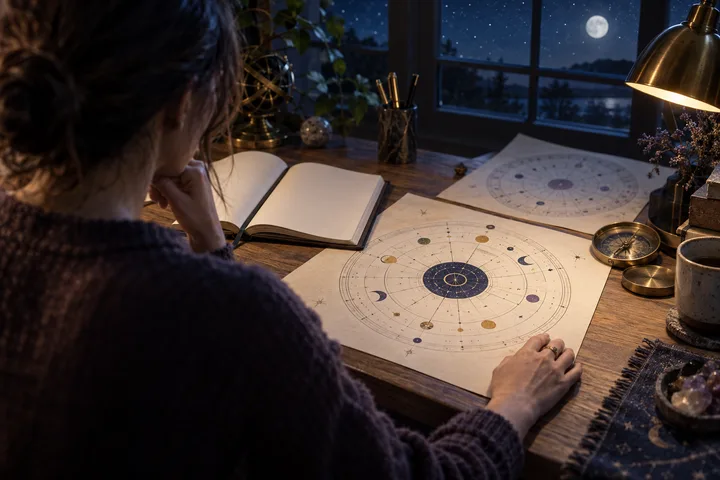
Synastry shows what each person activates in the other. A composite chart shifts the viewpoint and treats the relationship as a unit. That makes it useful for a different question: what atmosphere forms when these two people act as a pair?
Cafe Astrology distinguishes the two methods in much the same way. Synastry compares the energies of two charts point by point. The composite describes the couple's shared pattern and quality of life. Astro.com describes a midpoint composite as a relationship chart calculated from the midpoints of two natal charts. The method matters, especially for angles and houses.
Suppose synastry feels electric while the composite emphasizes work, service, or public responsibility. The relationship may grow through making something together rather than through constant romantic intensity. That isn't a failed version of love. It is a different form of it.
Use the composite to ask what the pair creates. Then compare its symbolism with the calendar, promises, and response to a difficult week. A relationship pattern becomes convincing when it has a life outside the chart.
Sources: Synastry: The Astrology of Relationships, The Astrology Podcast; Composite Chart & Synastry, Cafe Astrology; Chart Types, Astrodienst
The strongest exception: meaning does not require a shared future
Here is the objection worth keeping. What if the chart feels more loving than life? What if the connection changes you, returns in dreams, or awakens a part of you that had gone quiet, while the other person cannot meet you in the same visible way? Must the whole experience become a mistake because participation is uneven?
No. An encounter may carry spiritual meaning without becoming a mutual long-term partnership. You can honor what it opened without assigning the other person a promise they haven't made.
Neptune can symbolize devotion, imagination, and the unseen. It can also make silence feel like confirmation. Pluto can expose desire, fear, power, grief, and transformation. It can deepen honesty, or tempt one person to call control care. The task is not to flatten those symbols. It is to give vision a place beside consent, promises, limits, and choices.
The honest conclusion may be: this mattered, and it isn't becoming the partnership I want. That sentence protects both truths. Meaning belongs to the encounter. A shared future belongs to two people.
Sources: Synastry: The Astrology of Relationships, The Astrology Podcast; What Is Synastry? Classical Relationship Astrology, Sira Nur Uysal
Test participation in the quiet evidence of ordinary life
Chemistry is loud. Participation is quieter. It appears in the second message, the plan made in advance, the remembered detail, and the question that doesn't turn back to the speaker.
Look at three movements. Initiative asks who starts contact and makes plans. Response asks whether the other person meets an invitation with attention. Continuity asks whether care remains after the mood changes. A demanding season can create a temporary imbalance. A settled pattern makes one person begin, explain, forgive, and restart everything.
Read that evidence beside the chart without making the chart carry more than it can. A Moon contact may help you name emotional familiarity. Venus may describe tenderness. Mars may describe pursuit. Saturn may describe duty. None of them can make an unequal exchange mutual by naming it.
Ask one concrete question: what has each person done recently that made room for the other's life? The answer will be less glamorous than a soulmate number. It will also be more useful.

Repair tells you more than a perfect beginning
Every meaningful bond eventually leaves the first impression behind. Then the real question arrives. Can both people stay present after disappointment? Can they name harm without turning the conversation into a trial? Can they return after defense has taken over?
A repair has a shape. Someone names what happened. The effect becomes specific. The person who caused the harm takes responsibility without demanding instant comfort. Both people agree on a change, and later behavior tests the agreement.
Imagine a couple caught in a repeating Moon-Mars argument. One person becomes sharp when dismissed. The other becomes forceful when shut out. They agree that either person can call a pause, but the person asking for space must name a time to resume. The aspect hasn't changed. Its expression has a chance to change.
Watch what happens next. Do they adjust the agreement when it fails? Does the pause become a way to disappear, or does it create room to return? Participation appears in that revision. Repair doesn't mean endless tolerance. If one person repeatedly breaks trust and calls the pain a karmic lesson, the chart has become an excuse.
Use one plain record after the next rupture: what happened, what it changed, and what behavior would help. If both people can work with that record, the bond has a living method. If one person refuses every form of accountability, that refusal is information.
Sources: Synastry: The Astrology of Relationships, The Astrology Podcast; What Is Synastry? Classical Relationship Astrology, Sira Nur Uysal
A short reflection method for the next honest step
Start with the available chart inputs. Write down the zodiac, house method, aspect scope, and whether both birth times are known. If a time is missing, leave houses and angles open. Don't turn an unknown into a verdict.
Make two columns. In one, write what the chart seems to activate: longing, comfort, pursuit, fear, duty, or change. In the other, write what has happened: who initiated, who followed through, what each person disclosed, and what changed after conflict. Then add one question to each row.
Read in order. First, name the recognition. Next, ask what each person activates and receives. Then compare intensity with capacity. If you use a composite, ask what the relationship creates as a unit and identify the method. Finally, review repair. Who returns? Who changes? Who can hear a need without making it a threat?
Consider an example. The chemistry may be mutual and the composite may point toward shared creative work, while one person still avoids naming the future. The bond has meaning. Its potential may be real. Its future remains unchosen.
Return to the opening question with one prompt: what are we both willing to build during the next season? Put the answer in terms of time, behavior, and limits. If the reply is warm but has no action, keep the future open. If it is difficult but honest, use that truth. [Explore the Connection Reflection Report](/compatibility-test) when you want recognition, intensity, repair, and shared future held in one reflection.
You don't need a grand vow to learn whether participation is present. Choose the next honest action both people can name. Then watch what survives ordinary life. Recognition may explain why the door opened. Repeated participation shows whether anyone is building beyond it.
Sources: Synastry: The Astrology of Relationships, The Astrology Podcast; Composite Chart & Synastry, Cafe Astrology; What Is Synastry? Classical Relationship Astrology, Sira Nur Uysal
Sources & further reading
- Synastry: The Astrology of Relationships, The Astrology Podcast
Supports synastry as comparison of birth charts, natal-first context, house overlays, cross-aspects, and the distinction between dynamics and their resolution.
- Composite Chart & Synastry, Cafe Astrology
Supports the distinction between point-by-point synastry and a composite chart read as the relationship's shared pattern and quality of life.
- What Is Synastry? Classical Relationship Astrology, Sira Nur Uysal
Supports classical attention to Venus, Mars, the lights, the seventh house, planetary condition, and synastry as tendency rather than fixed fate.
- Chart Types, Astrodienst
Supports identifying the midpoint composite method and keeping chart construction choices explicit when reading relationship charts.
Complete Connection Meaning Report
Eighteen private reflections become a complete 12-section reading of recognition, mutuality, repair and your possible future.
Explore my connection