
Imagine the connection after the magic has a schedule
Imagine Maria and Elias meeting at a small dinner in early spring. They don't spend the evening performing for each other. They talk in the kitchen while everyone else argues over music. Maria tells him something she usually edits out. Elias doesn't rush to fix it. He listens, asks one careful question, and remembers the answer the next week. When they part, she feels a strange familiarity. Not certainty. Recognition.
For the first few months, the connection seems to gather its own weather. A look across a room says enough. They notice the same songs, finish each other's sentences, and speak about old grief with the ease of people who have already met in another chapter. Their attraction is real. So is the sense that the meeting matters.
Then ordinary life arrives. Elias gets a demanding project. Maria's sister needs help after a move. One of them wants to save for a home; the other wants to travel for a year. Their messages become less lyrical. They disagree about money. A missed call carries more weight than it should. The question changes. It is no longer, ‘Why does this feel so rare?’ It becomes, ‘Can this rare feeling live inside a real week?’
That is the question underneath the question about stability. People often fear that a lasting relationship must become dull, that the apartment, grocery list, and repeated conversation will flatten the mystery. But a bond doesn't become ordinary simply because it has a routine. It becomes ordinary when the two people stop bringing attention to it. Routine can hold meaning. A shared breakfast can carry more devotion than a dramatic reunion if both people remain present for it.
The danger lies in confusing intensity with proof. A connection can feel fated because it activates deep needs, old memories, desire, or a longing to be known. That feeling deserves respect. It doesn't deserve to make every later fact disappear. If one person keeps withdrawing, refuses repair, or asks the other to live on promises, the original recognition cannot do the work of a relationship.
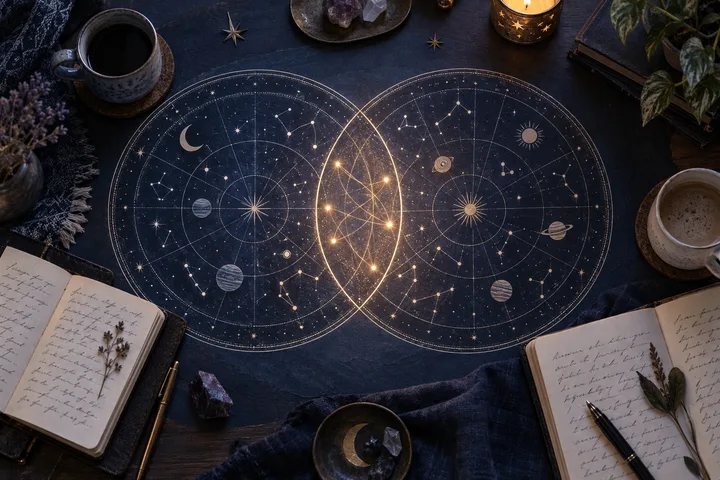
Astrology gives this experience a language. Synastry compares two natal charts by layering one person's planets and points over the other's, then reading the aspects, signs, and houses created between them. The chart may show why Maria feels at home with Elias, why his Saturn steadies or constrains her Moon, or why her Venus awakens his Mars. It describes the meeting between their patterns. It doesn't erase the choices made after the meeting.
So stability is not the enemy of a soulmate connection. It is the place where the connection reveals its depth. If the bond can hold repetition without losing tenderness, disagreement without turning into a trial, and growth without demanding sameness, it has not become less meaningful. It has become inhabitable.
Sources: What Is a Synastry Chart? Birth Chart Compatibility; Saturn in Synastry; What's Your Sign? An Intro to Synastry Charts and Astrological Compatibility
What recognition can tell you, and what it cannot
Recognition is often the first evidence people bring to a soulmate question. You may feel that you can speak without translating yourself. You may sense that the other person understands a private part of you before you have explained it. The meeting can feel familiar, quick, and strangely well timed. Those experiences matter. They are not childish, and they are not too vague to examine.
In synastry, astrologers often look to contacts involving the Sun and Moon, the Moon and Venus, personal planets on the Ascendant or Descendant, and the lunar nodes. A close Sun-Moon contact can join one person's sense of self with the other's emotional world. Moon-Venus contacts can bring a natural feeling of being cared for and appreciated. A planet on the Descendant can make someone seem to carry qualities you already associate with partnership. These are not interchangeable symbols. Each describes a different kind of recognition.
The distinction matters because recognition is not the same as readiness. Someone can understand your inner world and still lack the capacity to build with you. Someone can awaken your tenderness and still avoid difficult conversations. Someone can feel like home while asking you to remain outside their actual life. The chart may describe the pull accurately. The pull still needs a place to go.
Think of recognition as an opening, not a verdict. It tells you that the relationship has touched something important. It may reveal emotional familiarity, erotic charge, spiritual meaning, or a lesson that neither person can ignore. It does not tell you whether both people can organize time, keep promises, share decisions, and stay kind when the first image of each other breaks.
This is where the idea of a soulmate can become too narrow. If soulmate means only the person who produces the strongest feeling, then every intense bond becomes a candidate, including connections built on uncertainty and absence. If it means a person with whom the soul can meet reality honestly, the standard becomes more useful. The connection must remain meaningful when neither person is trying to create a special moment.
Maria notices this shift with Elias. At first, he seems to know when she needs closeness. Later, she sees that he also needs direct requests. His intuition is warm but inconsistent. Her own habits are not innocent either. She expects him to notice what she hasn't said, then feels disappointed when he misses it. Recognition gave them a beginning. It cannot replace language.
The most honest reading holds both truths at once. The familiarity may be real. The relationship may still be unready. When you ask what the connection means, ask what it is inviting you to see. Then ask a harder question: what does it require from both of you if its meaning is going to become a shared life?
Test recognition by asking what it lets you learn. When Maria discovers that Elias handles pressure badly, does the revelation make her curious, or does she defend the first impression at any cost? When he sees that her need for reassurance can become a demand for constant proof, can he tell her without turning cold? Familiarity that can absorb new information grows wiser. Familiarity that needs both people to remain idealized becomes fragile. In chart language, a Sun-Moon or Moon-Venus contact may describe the ease of the first meeting, while Mercury and Saturn show more about how the pair handles facts, time, and correction. The useful reading holds the whole pattern together.
Yes. A soulmate connection can become stable without becoming empty, but stability changes what the bond asks of you. The first rush of recognition may soften. The relationship then has to prove its meaning through shared routines, honest choices, emotional safety, and repair after disappointment. In astrology, synastry can show why two people feel familiar, desired, understood, or bound to one another. Moon and Venus contacts can speak to comfort and affection. Sun and Moon contacts can describe intuitive recognition. Saturn can give a bond weight, time, and responsibility, but it can also turn closeness into control when fear takes over. None of those signatures can substitute for two people choosing the relationship in ordinary life. The strongest answer is not that the connection stays extraordinary every day. It is that the connection keeps making daily life more truthful, more mutual, and more able to recover after strain. Explore your connection through the chart, then compare its story with what you actually do together.
Sources: What Is a Synastry Chart? Birth Chart Compatibility; What's Your Sign? An Intro to Synastry Charts and Astrological Compatibility; Love & Relationship Astrology: A Cosmic Guide to Compatibility
When intensity fades, does the bond disappear?
Many people treat the first intensity as the connection's purest form. They assume that if the constant messages slow, the attraction has weakened, or the relationship feels calm, something precious has been lost. That interpretation can make peace feel suspicious. It can also keep a couple attached to crisis because crisis proves that the bond still has heat.
Intensity has several sources. Desire can make time feel urgent. Uncertainty can make every silence loud. A difficult beginning can create relief when contact returns. Projection can fill the unknown person with qualities you hope to meet. Astrology can add another layer when a chart contains strong Venus-Mars, Pluto, Uranus, or nodal themes. Such contacts may describe fascination, erotic force, disruption, or a sense of significance. They can be life-changing. They do not all describe the same kind of future.
The more useful question is what remains when the nervous system no longer has to chase the next sign. Do you still enjoy each other's company? Can you tell the truth without fearing withdrawal? Does desire have room to change shape? Do you remain curious about one another after the mystery becomes familiar? A lasting connection doesn't need the same emotional temperature every day. It needs enough warmth to keep meeting.
Astrology gives Venus and Mars a visible role in attraction. Venus speaks to affection, taste, pleasure, and the ways love is offered and received. Mars speaks to drive, pursuit, heat, anger, and physical desire. A Venus-Mars contact can make the body answer quickly. That answer is important. It is also only one layer. Moon contacts ask how comfort moves between you. Mercury asks how you speak and solve. Saturn asks what you can carry over time.
This is why a quieter phase can be a test rather than a decline. If affection becomes more deliberate, if sex becomes more honest, or if the couple starts building rituals that suit both people, the bond may be maturing. If calm arrives because one person has stopped asking for anything, it may be resignation instead. The outside shape looks similar. The inner movement is different.
Maria and Elias lose some of their early rush after eighteen months. They also gain something they didn't have at dinner: a shared way to return after tension. He now says when work has consumed him instead of vanishing. She asks for reassurance instead of turning silence into a prophecy. The connection feels less cinematic. It feels more trustworthy.
The strongest meaningful exception is a relationship whose intensity is not merely changing but steadily collapsing into indifference. Stability cannot rescue a bond that no longer contains care, attraction, respect, or interest. Calm is not always depth. Sometimes it is distance. Read the pattern, not the label.
Give the quieter phase three questions. Are you still interested in the person, not only in the history you share? Can each of you bring a new desire or worry without being punished for changing? Does time apart leave room for reunion, or does it simply make absence easier? Three yeses suggest that intensity has found a calmer form. Repeated noes point toward withdrawal, even if the chart still carries a powerful Venus-Mars spark or a compelling Uranus or Pluto signature. The stars may explain why the bond remains charged. They don't ask you to call loneliness intimacy.
Sources: What Is a Synastry Chart? Birth Chart Compatibility; Love & Relationship Astrology: A Cosmic Guide to Compatibility
Saturn can make love durable, but it cannot make it alive
If recognition opens the door, Saturn asks whether anyone is willing to keep showing up. In relationship astrology, Saturn is linked with time, responsibility, limits, endurance, and the structures that make a promise real. A Saturn contact can feel serious from the beginning. The bond may seem weighty, familiar, or difficult to dismiss. Some couples experience that weight as safety. Others first experience it as fear.
A close Saturn contact to the Sun, Moon, Venus, Mars, or an angle can describe a relationship that changes both people. The Saturn person may provide steadiness, perspective, or a container for growth. The personal-planet person may bring warmth, feeling, desire, or movement into Saturn's more guarded world. When the contact works well, the couple can build a rhythm that survives seasons of pressure.
But Saturn has a shadow. The same wish to preserve the bond can become a wish to preserve the original version of the bond. One person begins to criticize the other's friends, humor, ambitions, or changing needs. The relationship calls this loyalty. The other person experiences it as supervision. A promise becomes a rule. Familiarity turns into a demand not to evolve.
Cafe Astrology's discussion of Saturn in synastry describes this double movement clearly. Saturn interaspects may create familiarity and safety, yet fear of change can make growth feel threatening. The article uses examples in which one partner's joy or independent interests slowly become targets of disapproval. That is a useful warning for soulmate language. A bond can be binding without being kind.
A healthy Saturn connection doesn't ask you to stay recognizable at all costs. It asks you to take the relationship seriously enough to tell the truth, name limits, and make decisions that have consequences. It can support commitment without demanding ownership. It can say, ‘I am here for the long work,’ without saying, ‘You must remain who you were when I met you.’
Maria sees the issue when Elias jokes that her new course is a phase and asks why she needs friends he doesn't know. He thinks he is protecting their closeness. She feels the old warmth narrowing around her. The chart could explain why his Saturn lands heavily on her personal planet. It could not excuse the behavior. The interpretation becomes useful only when it helps them recognize the pattern and choose a different one.
Saturn can make a soulmate connection stable when both people use its gifts: patience, duty, honest limits, and sustained effort. Saturn cannot make a dead relationship alive. It cannot turn fear into trust by itself. The question is not whether the chart contains enough Saturn. The question is whether the responsibility it describes is being shared.
Shared responsibility has a sound you can hear. It appears when both people remember the appointment, carry the awkward task, and bring up the subject that would be easier to avoid. It appears when commitment makes each person's world larger instead of smaller. Saturn's maturity is not grim endurance. It is the ability to keep a promise while allowing the promise to meet the person you are becoming.
That is why a Saturn contact should never be read in isolation. A binding tie can hold tenderness, but it can also hold fear. Look at what surrounds it. Is there enough Moon or Venus language for warmth? Is there enough Mercury for honest negotiation? Does the wider relationship allow Mars to act directly rather than through resentment? These questions don't weaken Saturn's meaning. They show whether its structure has a living heart.
Sources: Saturn in Synastry; What's Your Sign? An Intro to Synastry Charts and Astrological Compatibility; Love & Relationship Astrology: A Cosmic Guide to Compatibility
The chart can show the bond, but the relationship must show mutuality
A connection can be profound for one person and only possible for the other. That doesn't make the first person's experience false. It means the meaning is not yet mutual. This is one of the hardest truths in soulmate language because the word seems to promise recognition on both sides. Real life is less symmetrical.
Synastry is a comparison of two charts. It can show where one person's planet activates the other's Moon, Venus, Saturn, angles, or houses. It can describe how the contact may feel from each role. The chart is relational, but the reading still has to distinguish potential from participation. A Venus contact may create affection. It doesn't prove that both people are willing to act on it. A seventh-house overlay may make partnership feel imaginable. It doesn't announce a shared decision.
This distinction protects the sacred part of the experience. If you treat a chart signature as proof that someone must choose you, you turn spiritual meaning into a demand. The connection becomes a case you argue instead of a relationship you inhabit. The better use of astrology is more exact. It helps you name the kind of meeting that has occurred, then asks whether your conduct matches its promise.
Look for mutuality in plain actions. Both people make room for contact. Both can ask and answer direct questions. Both notice when the other is hurt. Both accept that a future requires more than private feeling. When a decision affects both lives, both participate in making it. When one person repairs, the other doesn't treat repair as a permanent debt.
Maria and Elias discover that they agree about love but not about pace. Maria wants a clear plan for living together. Elias wants to keep the relationship open-ended because he fears that naming a future will make it smaller. Their synastry may contain beautiful recognition. The present question is practical: can they negotiate a future without one person carrying all the uncertainty?
This is also where the idea of an ‘ordinary’ relationship needs repair. Shared chores, family obligations, health changes, and money meetings don't lower a connection's spiritual value. They reveal whether the value can move through hands. A soulmate bond that stays private, vague, or permanently postponed may remain intense, but it has not yet become stable.
The strongest sign of mutuality is not that both people use the same language. Elias may never call the relationship a soulmate connection. He can still participate fully. Maria may speak about spiritual meaning while learning to make concrete requests. Different words are fine. Shared responsibility is not optional.
Mutuality is easier to see when you stop measuring declarations and watch sequences. One person asks for a change. The other responds. The first person notices whether the response lasts beyond one emotional evening. Then the second person gets to ask for something, and the pattern reverses. Over time, both people should have evidence that their needs can enter the relationship without being mocked, postponed forever, or turned into proof of disloyalty.
A useful comparison is simple. Recognition answers, ‘Why did this person reach me so quickly?’ Mutuality answers, ‘Do we both make room for what this bond asks of us?’ Repair answers, ‘What happens after one of us gets it wrong?’ You can have the first without the second, or mutual affection without the skill to repair. Stability needs all three, but they don't arrive at the same speed.
Try a small mutuality experiment before making a large promise. Choose one ordinary point of friction, such as planning time together, responding after conflict, or protecting each person's friendships. Each person names one change they will make. Set a date within the next month to ask what happened. The point isn't to grade the relationship or force a perfect result. It is to see whether both people can turn a shared insight into a shared practice. A chart theme such as Moon-Saturn or Mercury-Mars may give the conversation a name, but the experiment supplies the evidence. If only one person prepares, remembers, and follows up, the connection is meaningful to someone. It isn't yet mutual enough to carry a future.
Sources: What Is a Synastry Chart? Birth Chart Compatibility; Love & Relationship Astrology: A Cosmic Guide to Compatibility
Repair is where a meaningful connection becomes livable
Every lasting relationship loses its first shape. Someone disappoints someone. A need goes unspoken. A family crisis takes over. One person grows faster in one area and slower in another. The question isn't whether the connection will be tested. It is what the two people do after the test exposes them.
Astrology can help describe the kind of friction a couple may meet. A hard Moon-Saturn contact may bring sensitivity around care, dependence, or emotional timing. A Mercury-Mars pattern may turn conversation into combat when one person wants speed and the other wants proof. Venus-Uranus may need freedom and freshness, while Venus-Pluto may want total emotional depth. These signatures can show a recurring theme. They do not decide the response.
Repair begins when the couple stops treating the pattern as a personality sentence. ‘You are cold because you're Saturn’ is not an interpretation. It's a verdict. A better reading says, ‘When I reach for comfort, you become practical. When you become practical, I feel dismissed. What would help us meet in the middle?’ The chart gives language to the loop. The people still have to interrupt it.
A real apology is only the first movement. Repair asks what changed afterward. Did the person name the behavior without hiding behind intention? Did they understand the effect? Did they make a specific adjustment? Did the other person allow a new attempt instead of demanding a flawless performance? A connection becomes more stable when both people learn how to return, not when they stop making mistakes.
You can read that change as a sequence rather than a mood. First, the hurt becomes speakable. Then the person who caused it stays present long enough to hear the full effect. Next comes a concrete alteration: a call gets returned, a boundary is respected, a joke stops, or a difficult decision is brought into the open. The final test arrives later, when the same pressure returns and the new response has to survive fatigue. One good conversation can open repair. Repeated new behavior is what gives it weight. This is also where astrology becomes more useful than a fixed label. A Moon-Saturn pattern may show why care feels guarded, but the couple can ask whether the guard is softening. A Mercury-Mars pattern may show why conflict accelerates, but the couple can watch for a slower opening move. The symbol names the weather. The practice shows whether anyone has learned to live in it.
Consider an example. Maria tells Elias that his jokes about her work have made her stop sharing good news. Elias first says he was only teasing. The old pattern would end there. The new pattern gives the hurt a full sentence. He acknowledges that the jokes protected him from feeling left behind. She tells him she needs interest, not applause. He agrees to ask before making light of something important to her. She agrees to tell him sooner when she feels alone.
That exchange doesn't make the relationship ordinary. It makes the relationship more real. Their shared meaning now includes a difficult fact: closeness brings fear to the surface. It also includes a practice for meeting that fear without using it as a weapon.
Repair has limits. If one person repeatedly harms the other, refuses responsibility, or treats forgiveness as permission to continue, the spiritual meaning of the bond does not require endurance. A soulmate connection can teach through an ending. Stability is not the same as staying at any cost. It is the presence of enough truth and safety for both people to remain whole.

Sources: Saturn in Synastry; Love & Relationship Astrology: A Cosmic Guide to Compatibility
How the same connection changes under different circumstances
The chart does not float above life. The same synastry can feel different at twenty-five and forty-five, during a season of health and a season of grief, at the start of a romance and after a decade of shared responsibility. Natal charts matter because each person brings an established pattern to the meeting. Timing matters because that pattern is being asked to act inside a particular chapter.
A Venus-Mars connection may feel like a bright beginning when both people have room for desire and adventure. During illness, parenting, or exhaustion, the same chemistry may need gentler forms of expression. A Saturn contact may feel stabilizing when one person wants a home base. Under financial stress, it may surface as fear, control, or a struggle over who decides. A Moon-Venus contact may create easy tenderness, but it cannot prevent one partner from having needs the other doesn't yet know how to hold.
House overlays add another layer. A partner's planets in the first house may affect identity and presence. In the fourth, they can stir home, family, roots, and private life. In the seventh, they may make partnership vivid and unavoidable. In the eighth, intimacy, trust, shared resources, and vulnerability may deepen. In the eleventh, friendship, community, and future hopes can become central. These meanings are interpretive. They depend on the natal chart, the condition of the planets, the exact birth data, and the wider pattern.
Choose the chart that matches the question. Synastry compares the two people and shows how one person's planets meet the other's chart. A composite chart is calculated from the two natal charts and read as the relationship's own field. If you are asking, ‘Why do I feel changed by this person?’ begin with synastry. If you are asking, ‘What kind of life does this partnership create when we act together?’ a composite can add another layer. One method doesn't cancel the other, and neither replaces the lived relationship.
This is why a responsible reading states its inputs. A full synastry reading requires both people's birth dates, accurate birth times when houses and angles matter, birth places, the zodiac system being used, and a clear aspect or orb policy. This article does not calculate Maria and Elias's charts. Their story is illustrative. No degrees, house placements, or personal chart positions are being presented as facts about them.
The circumstances can also change the answer without changing the meaning. Two people may share a genuine soulmate bond and still need to live apart for a period while caring for a parent. A couple may love each other while disagreeing about children, religion, money, or home. The connection can remain sacred. The shared future may still be unworkable unless the disagreement has a path through it.
Astrology is most helpful here when it widens the question. Instead of asking, ‘Does this chart guarantee forever?’ ask, ‘What does this bond ask us to learn about closeness, freedom, duty, and change in this season?’ That question honors both the stars and the facts on the ground.
Stability is not one fixed shape. For one couple, it means a household. For another, it means a dependable partnership across distance. For a third, it means a loving ending that stops the pattern from becoming cruel. The chart can help you understand the kind of tie you share. Your circumstances decide which form of truth you can live.
Those practical differences are not details beneath the spiritual story. They're where the story asks to become honest. A relationship can be meaningful and still require a slower plan, a different form of commitment, or a clean admission that love can't solve every conflict of direction.
If birth times are uncertain, keep the reading at the level the data can carry. Planet-to-planet contacts may remain useful when the relevant positions are secure, while houses and angles can shift with the time. If the Moon is close to a sign or aspect boundary, say so before building the interpretation around it. Precision is a form of respect here. It keeps the chart from becoming an ornament placed over a conclusion you already wanted.
Sources: What Is a Synastry Chart? Birth Chart Compatibility; Love & Relationship Astrology: A Cosmic Guide to Compatibility; Partner Comparison
The answer is not to preserve the mystery, but to deepen it
A soulmate connection can last without staying dramatic. In fact, it may last because it learns to stop performing its significance. The mystery doesn't have to disappear. It can move inward. You discover that the person who once felt uncannily familiar is also someone whose habits you must understand. You learn that love is not only the moment of being seen. It is the discipline of continuing to see.
Maria and Elias reach a decision after a year of difficult conversations. They don't promise that living together will solve their differences. They agree on a trial year with a clear division of expenses, protected time with friends, and a monthly conversation about the future. They set a date to review what is working. The plan is not romantic in the way their first dinner was romantic. It is romantic in a deeper sense. It gives the connection a body.
Their arrangement also leaves room for the strongest exception. If the trial reveals that one person keeps shrinking while the other calls it commitment, they will not use the chart to overrule that knowledge. If the relationship becomes more spacious, more honest, and more capable of repair, they will let stability count as evidence. Not proof of destiny. Evidence of a shared choice.
This is the governing judgment. A soulmate bond becomes stable without becoming ordinary when it translates recognition into mutual participation. Intensity may open the story. Saturn may give it duration. Moon, Venus, Mercury, Mars, the angles, houses, and nodes may describe the ways two people touch each other's lives. But repair and shared decision-making determine whether the bond can keep its meaning under pressure.
The common idea this rejects is that stability must either kill the magic or prove the relationship forever. Both are too simple. Some relationships become calm because they have matured. Some become calm because one person has gone numb. Some connections are meant to remain important without becoming a shared home. The work is not to force one outcome. It is to tell these possibilities apart.
If you want to reflect on your own connection, make three columns on a page. In the first, write what you felt and the chart theme you think it touched. In the second, record what each person actually did. In the third, write what changed afterward. Use three moments when the bond felt unmistakably alive and three moments that tested it. This keeps the chart in its proper place. It can illuminate a pattern, but the sequence of actions tells you whether the pattern is becoming a shared practice. If the second and third columns stay thin, the feeling may be carrying more of the relationship than the relationship can carry for you.
Then make one decision. Have the conversation you've postponed. Set the boundary that would make closeness safer. Make a shared plan with a date to revisit it. Or admit that the connection has meaning without offering the future you want. A soulmate connection doesn't become less sacred when you choose the truth. The meaning that survives an ordinary Tuesday, a hard conversation, a change of plan, and a sincere repair is not smaller than the first spark. It is the spark with roots.
Sources: Saturn in Synastry; Love & Relationship Astrology: A Cosmic Guide to Compatibility
A little more clarity
Can a soulmate connection become less intense and still be real?
Yes. Intensity often changes when a bond becomes safer and more familiar. The better test is what replaces the rush. If you find steadier affection, honest communication, shared responsibility, and repair after conflict, the connection may be deepening. If the calm comes from indifference, avoidance, or one person carrying the relationship alone, stability is only a name for distance. Astrology can help describe why the bond felt powerful and how its emotional, romantic, and structural themes interact. It cannot turn a one-sided choice into mutual commitment.
Sources & further reading
- What Is a Synastry Chart? Birth Chart Compatibility
Supports the definition of synastry, chart layering, houses, aspects, signs, and the interpretation of Moon, Venus, Sun, Mercury, and Saturn contacts.
- Saturn in Synastry
Supports the double movement of Saturn contacts toward familiarity and commitment, and their shadow involving fear, restriction, criticism, and resistance to growth.
- What's Your Sign? An Intro to Synastry Charts and Astrological Compatibility
Supports interpretive meanings for Sun-Moon, Moon-Venus, Venus-Mars, angle contacts, Saturn, degrees, and the role of commitment in relationship astrology.
- Love & Relationship Astrology: A Cosmic Guide to Compatibility
Supports the layered reading of planets, signs, houses, Moon, Venus, Mars, communication, and the view that relationship longevity includes both ease and challenge.
- Partner Comparison
Supports distinguishing synastry from composite and Davison approaches when comparing two relationship charts.
Complete Connection Meaning Report
Eighteen private reflections become a complete 12-section reading of recognition, mutuality, repair and your possible future.
Explore my connection