
A meaningful connection responds to family rejection by separating love from approval, then testing the bond in real life. Your family may be reacting to culture, fear, timing, control, or a genuine concern. Your partner may be asking for patience, secrecy, or a boundary. Those are different facts. Astrologically, the family story belongs to the Moon, the fourth house, the IC, and the patterns that describe home, ancestry, and emotional safety. The partnership story belongs to the seventh house and the synastry contacts that show how two people meet, unsettle, support, and limit one another. Read both layers. Then watch what the relationship does under pressure. A lasting bond does not need universal approval, but it does need two people who can name the cost, protect each other without isolating each other, and make a practical plan. Start with one calm conversation about what your family’s objection is, what your partner needs, and what neither of you will surrender.
The first question is not whether your family is right
You are sitting at a table. Someone you love has just called the relationship a mistake, a phase, a betrayal, or something that cannot possibly belong in the family. The words sound certain. Your feelings may feel even more certain. Then a connection that once felt private becomes a public argument, and you have to decide whether to defend it, hide it, pause it, or ask the person you love to wait.
The first question is not which side wins. It is what exactly is being rejected. A parent may object to a religion, nationality, age gap, previous marriage, social class, gender identity, distance, or the fear of losing influence. A sibling may be protecting an old family role. A partner may be asking you to cross a line your family has drawn for generations. These situations look alike from the outside. They are not alike in meaning.
Begin with particulars. What did they say? What did they observe? What do they fear will happen? What has your partner actually done? Sort the objection into conduct, safety, honesty, custom, and control. That inventory gives the connection a fair hearing and keeps “my family dislikes this” from becoming a complete interpretation of the relationship.
Astrology gives this conflict more than one room. The fourth house describes roots, ancestry, family background, and the private conditions that make a person feel at home. The seventh house describes partnership, commitment, agreement, and the encounter with an equal other. The question is not which house is more powerful. It is whether the relationship can move from an inherited family story into a shared adult story without pretending the old story never shaped you.
Families often defend more than the person standing in front of them. They defend the future they pictured, the rituals they expected, and the place they thought you would occupy. You may be grieving that imagined future too. Grief doesn't prove the relationship is wrong. It may be the price of choosing a life your family has not learned to name.
Sources: The Fourth House: The House of Family and Home | Astrology.com; An Astrological Overview of the Family | Faculty of Astrological Studies; Synastry: The Astrology of Relationships | The Astrology Podcast transcript
Family resistance may be fear, control, or a warning
Family resistance carries information, but it doesn't carry one fixed meaning. Sometimes relatives notice a pattern you have been too hopeful to see. Sometimes they call a loving relationship illegitimate because it changes their access to you. Sometimes they're frightened by difference. Your task is to separate those signals before you answer them.
Ask them to leave the verdict behind and give you the evidence. “What have you seen?” is better than “Why don't you approve?” Listen for conduct: lies about money, dismissed boundaries, pressure to cut off friends, broken promises, or contempt dressed up as concern. Those are relationship facts, even when your family states them clumsily.
Also listen for belonging rules. “People like that never fit in.” “You're embarrassing us.” “If you choose them, you're no longer one of us.” Such words describe the family’s idea of membership. They may hurt deeply, but they don't establish danger by themselves.
The Moon is useful here. In family astrology, it speaks to attachment, early security, and the emotional safety net carried into adult relationships. When that safety net feels threatened, people can act from memory before they act from the present. A family may treat the unfamiliar as dangerous because the unfamiliar has always meant loss. You may also defend the relationship with unusual force because rejection touches an old wound. Naming that history lets you respond to the present instead of asking the present to heal every old wound.
Now test flexibility. Would your family revise its view if the facts changed? Would your partner change a plan if it harmed you? A concern can be examined. A verdict and an ultimatum demand surrender. Set one date for the next conversation, and notice who can respect the space between fear and decision.
Sources: An Astrological Overview of the Family | Faculty of Astrological Studies; Seventh House: Partnership, Commitment, Mirroring | Astrologus
Read the family story and the partnership story separately
A common mistake is to merge two questions: what does my family feel, and what is this relationship? The first concerns belonging, origin, loyalty, and inherited expectation. The second concerns mutual choice, conduct, desire, trust, and a future built by two people. They touch. They are not the same question.
In a chart, the fourth house and IC describe the ground beneath you: homeland, tradition, privacy, and family ritual. The Moon adds the felt memory of care and the reflex that appears when belonging feels uncertain. These symbols can explain why approval matters. They do not give relatives ownership of your adult partnership.
The seventh house asks whether you can meet another person as an equal, make terms, and negotiate without disappearing. That is the useful distinction here. Ask what your family is protecting, what your partner is asking you to protect, and what you would choose if neither side rewarded you for choosing it. The first answer belongs to history. The second belongs to the partnership. The third reveals your adult will.
This is also where the idea of legitimacy needs care. A family may treat legitimacy as resemblance: same faith, same class, same customs, same approval chain. A partnership may define legitimacy through something else: a clear choice, shared responsibility, and the freedom to tell the truth. Neither definition is weightless. But you are the person who must live with the definition every day, so you need to know which one your future can actually carry.

Sources: The Fourth House: The House of Family and Home | Astrology.com; Synastry: The Astrology of Relationships | The Astrology Podcast transcript; Seventh House: Partnership, Commitment, Mirroring | Astrologus
Synastry can show why the bond touches old family ground
When astrologers compare two natal charts, they are looking at synastry, the way one person’s planets and points activate the other person’s chart. This can make a meeting feel immediate. It can also make it feel loaded. A person does not arrive as a blank page. They touch houses, planets, memories, defenses, and hopes that were already there.
Contacts to the Moon can bring emotional recognition and quick sensitivity. Contacts to the fourth house, IC, or its ruler can bring home themes forward. One person may feel like shelter. Another may feel exposed inside the place where they usually hide. The same contact can comfort one person and unsettle the other.
Suppose one person’s Sun or Venus activates the other person’s fourth house. The relationship may awaken a longing to build a home that feels more honest than the home of origin. That longing is real. The couple still has to ask whether they are building a home together or using one another to escape an old one.
The chart won't settle the matter by naming a soulmate signature. It shows the kind of material that has been stirred. Use it to form a better sentence: “When my family questions us, I feel I have to choose immediately.” Then ask for a response you can observe. Symbolism becomes useful when it leads to a conversation, a promise, or a boundary.
Sources: Synastry: The Astrology of Relationships | The Astrology Podcast transcript; Saturnian Aspects and Practices: Stay Strong With Some Support | Astrology.com
The Saturn question: can love hold a boundary?
Family conflict often brings Saturn into the room, whether or not a chart has a prominent Saturn contact. Saturn represents limits, responsibility, time, rules, and the structures that hold a life together. In a family system, Saturn may appear as tradition, authority, duty, reputation, or fear of consequences. In a relationship, it asks whether affection can become a promise with weight.
That can feel harsh. A Saturn response says, “This is what I can offer. This is what I cannot permit. This is the cost.” A boundary is not punishment. It is a shared rule that protects dignity while leaving room for repair.
Saturn contacts in synastry are often read too quickly as doom or permanence. A serious contact can bring duty and endurance, but it can also bring criticism, fear, or unequal authority. A precise reading would require both birth dates, times, places, chosen zodiac, house system, and actual planetary degrees. Even then, symbolism describes a pressure and a task, not a guaranteed outcome.
Make the boundary concrete: “We will leave if the conversation becomes insulting. We will visit again when everyone can speak respectfully.” Agree on it privately first. A smaller promise both people keep for six months is stronger than a grand declaration abandoned after one difficult dinner.
Sources: Synastry: The Astrology of Relationships | The Astrology Podcast transcript; Saturnian Aspects and Practices: Stay Strong With Some Support | Astrology.com
A worked example: when love and loyalty pull in opposite directions
Imagine Maria has been with Daniel for two years. Daniel comes from a different faith. Maria’s parents believe the relationship will divide the family, especially if the couple marries or raises children. They ask Maria to end it. Daniel says he will support her, but he also wants her to stop attending family dinners because he cannot keep being treated as a problem to solve.
The first version is simple: her family is narrow-minded, or Daniel is isolating her. The fuller version needs detail. Maria’s parents have made insulting comments and demanded that she conceal the relationship from grandparents. Daniel has not threatened her friendships, but he has started treating every family invitation as a betrayal. Maria now carries messages between two camps. The relationship is meaningful. The current arrangement is unsustainable.
Astrologically, Maria might recognize a strong fourth-house or Moon emphasis in the way family belonging shapes her decisions, while a seventh-house emphasis describes the need to make a clear adult agreement. If synastry showed a partner’s planets activating her fourth house, that could illuminate why Daniel feels tied to the question of home. If Saturn contacted her Moon or relationship points, it might describe the weight of duty and the slow work of creating a boundary. These are interpretive possibilities, not Maria’s calculated chart positions.
Her next move is not to force a wedding or stage a dramatic break. Maria and Daniel need one private agreement. They can decide what respect looks like, which family events remain possible, how they will speak about faith, and whether children, holidays, and residence are negotiable. Maria then speaks to her parents without asking them to bless the relationship. Daniel speaks to her without asking her to erase her history. The bond has a chance only if both people stop making the other prove love through abandonment.
Notice what this example does not require. Maria does not have to call her parents evil. Daniel does not have to pretend their insults do not hurt. Neither person has to promise that every difference will be solved before they continue. They do need to agree on what they will do when the difference appears again. A future is not protected by perfect agreement. It is protected by a known response to recurring pressure.
Maria’s boundary might be, “I will not hide you to make the family comfortable, and I will not bring you into a room where you are being attacked.” Daniel’s boundary might be, “I will attend a respectful gathering, but I will leave when insults begin, and I will not ask you to cut off your parents as proof that you choose me.” Notice the difference between those sentences and an ultimatum. An ultimatum says, “Prove love by doing what I demand.” A boundary says, “Here is the action I will take to remain safe and honest.” The first creates a contest. The second creates information. Each person can see what the other is actually willing to carry.
If Maria’s parents later apologize, the couple can decide what contact becomes possible. If they do not, Maria can maintain a limited relationship without presenting Daniel for approval. If Daniel continues to treat every family connection as disloyal, Maria has new information about the partnership. If Maria continues to minimize every insult to keep the peace, Daniel has new information too. The point is not to predict which person will fail. It is to make the pattern visible early enough that choice remains possible.
This is why a worked example matters more than a list of soulmate signs. The same chart contact could be lived as courage, fear, patience, control, or repair. Astrology gives language to the pressure. The people involved give it form. When you read a relationship, ask not only what is activated, but who takes responsibility for what has been activated. That question keeps wonder connected to wisdom, and it protects the future from being built on feeling alone.
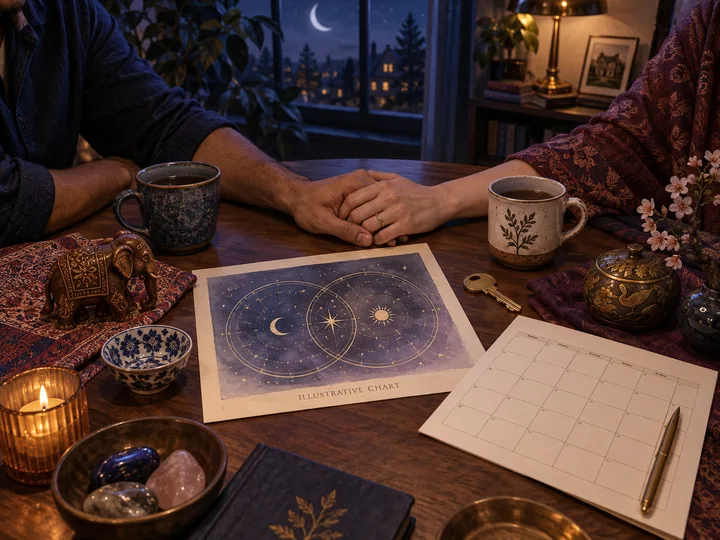
Mutual participation matters more than emotional intensity
A connection can feel extraordinary and still fail the test of participation. Family opposition may intensify the feeling, making every meeting precious and every message charged. Secrecy can start to feel like intimacy. Conflict can masquerade as proof that the relationship matters. Ask the plainer question: what does each person do when the feeling becomes costly?
Does your partner show up for hard conversations, make room for your grief about family, and take responsibility when their actions create more pressure? Do you do the same? Synastry can name the felt layer. A Moon contact may describe emotional pull, Venus affection, Mars desire or friction, Saturn patience and structure, and Neptune spiritual longing or blurred edges. None replaces the test of a promise kept.
Try a small test. Choose one family-related decision that can be completed in thirty days. Perhaps you will agree on what to disclose, attend one gathering for a set amount of time, or pause contact after a specific insult. Put the agreement in plain words. Then watch the follow-through. A promise becomes meaningful when you can see who keeps it, who revisits it, and who quietly expects the other person to carry it alone.
Make the test observable. “Stand beside me” might mean correcting an insult or leaving with you. “Protect us” might mean telling the truth without using your partner as a shield. Choose one conversation, one time limit, and one follow-up. If the request cannot be seen or completed, it cannot tell you much about the bond.
Sources: Synastry: The Astrology of Relationships | The Astrology Podcast transcript; Seventh House: Partnership, Commitment, Mirroring | Astrologus
The strongest exception: sometimes family sees what romance hides
The strongest exception matters. Family prejudice is real, but family concern is not always prejudice. A meaningful feeling can coexist with manipulation, dishonesty, addiction, contempt, coercion, or a pattern of broken promises. If several people who care for you name the same concrete behavior, do not dismiss them simply because the relationship feels spiritual or rare.
Ask whether the concern survives specifics. Can you verify the facts? Has your partner answered direct questions without turning them back on you? Do they respect your no when no family member is watching? Can they disagree without threatening withdrawal, exposure, or revenge? Does the relationship leave you more able to think, work, sleep, and maintain your other bonds, or does it require constant crisis management?
Astrology does not excuse conduct. A difficult synastry contact can become a shared practice, but only if both people recognize the pattern and change how they meet it. A beautiful contact can be unused. Character appears in the response.
If there is immediate danger, coercion, or a credible threat, safety outranks the romance and the family debate. Seek trusted local support and make a plan that protects your freedom to leave. You do not need to defend a connection by staying in harm. Spiritual meaning never requires you to surrender your judgment. The bond worth preserving can survive an honest look at reality.
A family can be wrong about your partner’s culture and right about their treatment of you. A partner can be wounded by your family and still behave badly when challenged. Keep both facts in view until the evidence separates them. Then look for repair: acknowledgement, changed conduct, and room for your account without a loyalty test.

Sources: Synastry: The Astrology of Relationships | The Astrology Podcast transcript; Saturnian Aspects and Practices: Stay Strong With Some Support | Astrology.com
Build a shared future without demanding one shared family
Many couples assume lasting love requires both families to become one warm circle. That is one possible future. It is not the only one. A shared future can include separate holidays, different friendships, limited contact, two languages, two faith practices, or a chosen family that grows beside the family of origin rather than replacing it.
The practical work begins with the parts romance tends to postpone. Where will you live? How will you handle holidays, faith, children, and money that comes with conditions? These questions are not unromantic. They are how love becomes inhabitable.
Rank the decisions. First protect dignity and safety. Next settle the daily structure that keeps resentment from spreading. Then decide which family relationships can be repaired and which must remain more distant. Begin with the smallest repeated choice that will show whether you can cooperate.
Use two circles of commitment. The inner circle contains what only the couple decides: the relationship’s status, private conversations, shared home, and terms of repair. The outer circle contains what can be offered to relatives: invitations, information, visits, rituals, and chances to rebuild trust. Family doesn't get a vote in every private choice. The couple doesn't have to erase every outer relationship either.
Write three sentences together: what you will protect, what contact you can offer, and what happens after an insult. Then ask what each person fears losing: a language, holiday, parent’s affection, or the feeling of being a good child. Build a future that works whether the family softens or doesn't.
Sources: The Fourth House: The House of Family and Home | Astrology.com; Seventh House: Partnership, Commitment, Mirroring | Astrologus
What the connection means after the pressure arrives
Family rejection changes the meaning of a relationship because it removes the easy story. Before the conflict, you may have asked whether the connection felt familiar, magnetic, or spiritually important. Afterward, ask what kind of life that feeling can support. The answer may be larger than family approval. It may also be less flattering than the fantasy.
A connection that lasts under this pressure does not necessarily win everyone over. It becomes clear. The couple can say what they are choosing, what they are declining, and what they still do not know. They can stay tender without becoming fused. They can protect privacy without turning secrecy into a permanent home. They can repair after one person mishandles the boundary.
The chart can name the pressure. It can't do the choosing. Return to the table in the opening scene. You don't have to make the family approve tonight. Ask your partner for one shared boundary and one shared plan, then watch whether both of you keep them. That is the move from private feeling into adult partnership.
Don't hand your family the power to name the relationship, and don't hand your feelings the power to excuse it. Let the chart show where the pressure lives. Let repeated behavior show what the bond does. If your partner meets you with steadiness, curiosity, and accountability, keep building. If they answer rejection with isolation, contempt, or demands that you abandon yourself, take that seriously. If family cannot approve but can respect your boundary, leave a door open without leaving your life on the doorstep. For a fuller look at recognition, mutual participation, repair, and the future you are trying to build, Explore my connection through the Connection Reflection Report.
Sources: The Fourth House: The House of Family and Home | Astrology.com; Synastry: The Astrology of Relationships | The Astrology Podcast transcript; Seventh House: Partnership, Commitment, Mirroring | Astrologus; Saturnian Aspects and Practices: Stay Strong With Some Support | Astrology.com
A little more clarity
Can a soulmate-feeling relationship last if family never accepts it?
Yes, it can. The harder question is what the couple does with the cost of being opposed. They need clear boundaries, honest plans for home, faith, money, holidays, and contact, plus a way to repair when pressure exposes conflict between them. If the bond depends on secrecy, isolation, or one person repeatedly sacrificing their identity, family rejection has revealed a partnership problem that deserves attention.
What does astrology look at when family rejects a relationship?
An astrologer would examine the fourth house and IC for roots, home, ancestry, family patterns, and private security; the Moon for attachment and emotional safety; and the seventh house for partnership, commitment, equality, and negotiated terms. In synastry, contacts to these points can show why the relationship activates family material. Exact interpretation requires both people’s birth dates, times, places, chosen zodiac, house system, and planetary degrees. The symbolism describes themes and tasks, not an automatic verdict.
How can I tell whether my family’s objection is a warning or control?
Ask for specific observations. A warning concerns conduct you can examine, such as repeated lying, coercion, broken agreements, contempt, or pressure to abandon your support system. Control often appears as demands for obedience, shame about difference, threats of withdrawal, or refusal to discuss facts. Take credible concerns seriously, then judge the relationship by your partner’s behavior over time. A meaningful bond should make room for clear thinking, outside relationships, and your right to set a boundary.
Sources & further reading
- The Fourth House: The House of Family and Home | Astrology.com
Supports the fourth house as the astrological house of family, home, ancestry, roots, and private foundations.
- An Astrological Overview of the Family | Faculty of Astrological Studies
Supports the Moon as family home, attachment, early security, and emotional patterns in adult relationships.
- Synastry: The Astrology of Relationships | The Astrology Podcast transcript
Supports reading synastry as a process-oriented interaction that reveals repeating dynamics, invites self-reflection, and should not be reduced to a fatalistic verdict.
- Seventh House: Partnership, Commitment, Mirroring | Astrologus
Supports the seventh house as partnership, commitment, equality, negotiation, reciprocity, and mutual terms.
- Saturnian Aspects and Practices: Stay Strong With Some Support | Astrology.com
Supports Saturn as a symbol of limits, boundaries, discipline, responsibility, structure, and sustained effort.
Complete Connection Meaning Report
Eighteen private reflections become a complete 12-section reading of recognition, mutuality, repair and your possible future.
Explore my connection