
Yes, a meaningful connection can stay tender when both people grieve different versions of the future. But the feeling itself isn’t what keeps it alive. Grief makes the bond more intense, while Saturn, Pluto, the Moon, Venus, and eighth-house themes can show why the connection feels serious, familiar, or hard to release. They don’t promise that two people want the same life. The stronger sign is simpler: each person can name what has been lost, listen without trying to erase the loss, and make a new choice that includes the other. Tenderness lasts when love becomes mutual practice. If only one person keeps adapting, waiting, or translating pain into destiny, the connection may remain meaningful while the relationship stops being shared. Look for repair, room, and a future spoken in two voices.
The connection can be real and still face a real ending
A meaningful connection doesn’t become less meaningful because the future you imagined has changed. That’s the first thing to hold onto. People often panic at this point. They think the tenderness must have been false, or that the grief proves the relationship was destined to fail. Neither conclusion is necessary.
Two people can recognize each other deeply and still want different lives. One may be grieving the children they expected to have. The other may be grieving a career, a home, a family role, or a former self that no longer fits. Sometimes they’re grieving the same event from different rooms inside themselves. One wants to speak. The other wants silence. One wants to make a plan. The other can’t bear to make another promise.
This is where the question changes. It isn’t only, ‘Is this a soulmate connection?’ It becomes, ‘Can this bond make room for two honest futures?’ My answer is yes, but only when both people participate in the making. Intensity can keep you attached to a picture. Mutuality helps you meet the person who remains after the picture breaks.
Astrology gives language for the pressure. It can show why a relationship wakes old fears, creates a sense of duty, or opens a private emotional chamber. It can help you understand why the bond feels larger than its visible history. But a chart doesn’t make one person’s future more important than the other’s. The relationship still has to become a place where both people can tell the truth and respond to it.
That’s the governing judgment here. A connection stays tender through grief when it moves from shared feeling to shared choice. The weaker idea is that a powerful bond should be preserved at any cost. Sometimes love protects its tenderness by changing shape. Sometimes it chooses a new form together. Sometimes it admits that the old future is gone.
Pay attention to the word stay. It doesn’t mean that tenderness must feel the same every week. Grief changes its voice. At first, tenderness may look like holding each other through tears. Later, it may look like respecting a need for quiet, making room for a family obligation, or refusing to make a decision while one person is in shock. A relationship that lasts learns new forms of care instead of demanding the first form forever.
This matters because couples often judge the bond by its most dramatic moments. The night of the confession. The coincidence. The sense of having found home. Those moments can tell the truth about recognition. They don’t tell the whole truth about endurance. Endurance appears on a Tuesday, when one person is tired, the old plan is no longer possible, and both still choose to speak plainly.
The question is not whether love can defeat grief. Love doesn’t need to defeat it. The question is whether love can accompany grief without turning it into a test that one partner must pass.
Sources: Synastry: Moon-Saturn Aspects; Synastry: Moon-Pluto Aspects Between Two Charts; Synastry: Love and Relationship Astrology; Eighth House in Astrology: House of Transformation
Why grief can make a bond feel even more fated
Grief strips away small talk. It makes ordinary time feel thin. When someone meets you there, the recognition can feel startling. You may think, ‘You understand the part of me no one else sees.’ That experience matters. It can be sacred. It can also make the relationship carry more weight than either person has consciously agreed to carry.
The astrological language for this often gathers around the Moon, Pluto, Saturn, and the eighth house. The Moon speaks to emotional memory, safety, habit, and the private self. Pluto intensifies what it touches. Saturn gives weight, time, duty, and consequence. The eighth house is linked with intimacy, shared resources, loss, vulnerability, and the transformation that follows an ending. When these symbols are active in a synastry reading, people may feel that the relationship has entered the deepest part of life.
That does not mean the bond is imaginary. It means the bond is carrying material that changes people. A Moon-Pluto contact may bring powerful feelings and fear of loss. A Moon-Saturn contact may create seriousness and staying power, while also making the Moon person feel restrained if feelings are repeatedly censored. Eighth-house overlays can make trust, merging, grief, and shared survival impossible to keep at the surface.
The danger is easy to miss. When a relationship becomes the place where both people process mortality, family history, and lost futures, separation can feel like losing the entire meaning of the experience. You may cling to the person because you’re also clinging to who you became beside them. That is why intensity needs a second question. Not, ‘How much do we feel?’ Ask, ‘How do we treat each other when the feeling asks for a decision?’
Astrology’s deeper gift here is not a verdict of forever. It’s a map of the chamber you’ve entered. The map helps you see why the chamber is powerful. It doesn’t tell you to stay locked inside it.
There’s another reason grief can feel fated. It interrupts the usual order of a relationship. You may be learning someone’s childhood history while also discussing a hospital visit, a funeral, a move, or a financial decision. The bond skips ahead. It acquires a seriousness that time alone would normally create. That can be genuine intimacy, but it can also make you mistake compressed experience for tested compatibility.
Let the bond have both truths. You may have met each other in an unusually deep place. You may still need to discover whether you can share chores, money, conflict, family boundaries, and rest. The sacred and the ordinary aren’t rivals. The ordinary is where the sacred proves it can live.
If the connection only feels alive in crisis, ask what happens when no emergency is speaking for you. A lasting bond can hold depth in quiet seasons, too.
Recognition says, ‘Something in you feels known.’ Time asks, ‘Can we keep knowing each other as we change?’ That answer appears in repeated contact with limits, moods, habits, and choices. A couple may share a spiritual language and still have no method for deciding where to live or how to handle a family obligation. Don’t treat that gap as proof that the connection failed. Treat it as the first practical question the connection has raised.
Sources: Synastry: Moon-Saturn Aspects; Synastry: Moon-Pluto Aspects Between Two Charts; Eighth House in Astrology: House of Transformation
Moon-Saturn can hold love through difficulty, but it must leave room for feeling
Moon-Saturn synastry is often associated with commitment, seriousness, and endurance. It can feel like the relationship has a backbone. When life becomes difficult, one person may organize the practical world while the other carries the emotional weather. That steadiness can be a blessing during grief. Someone remembers the appointment. Someone pays the bill. Someone stays on the phone when there’s nothing useful to say.
But Saturn has a shadow. The Moon person may start editing their needs before they speak. They may decide that sadness is too much, that dependence is embarrassing, or that the Saturn person only wants the competent version of them. The Saturn person may believe they’re helping by being calm, corrective, or solution-focused. The Moon person experiences that help as distance.
Different futures make this pattern sharper. Suppose one partner wants to move closer to family after a loss, while the other wants to remain where the couple built its life. Saturn may say, ‘We need a responsible plan.’ The Moon may hear, ‘Your grief is not allowed to alter our life.’ Or the Moon may say, ‘I need you to come with me,’ while Saturn hears an impossible demand and retreats into duty.
The repair is not to remove Saturn. It is to soften the rule that Saturn has written. Practical care and emotional witness must sit at the same table. Before discussing budgets, dates, or logistics, name the loss. ‘I know this move means leaving the life we made here.’ ‘I know staying means I may feel farther from my family.’ Acknowledgment doesn’t settle the decision. It makes the decision human.
The most tender version of Moon-Saturn says, ‘Your feelings can exist without becoming an emergency, and my limits can exist without becoming rejection.’ That is a long-term promise worth more than dramatic reassurance. It gives grief somewhere to go.
Different grieving styles can make this aspect feel colder than it is. Saturn may mourn by handling tasks. The Moon may mourn by returning to memories and asking the same question many times. One style seeks order. The other seeks contact. Neither is automatically more loving. Trouble starts when a style becomes a moral judgment: practical means uncaring, or emotional means unstable.
Try translating the behavior before reacting to it. ‘When you start making lists, I assume you’re leaving me alone with the pain.’ ‘When you revisit the story, I assume you don’t trust the plan I’m trying to make.’ Those sentences reveal the hidden fear. Once it’s visible, Saturn can offer presence before solutions, and the Moon can ask for presence without demanding that every feeling become a permanent rule.
The aspect grows stronger when responsibility is shared. Let the Saturn person receive care. Let the Moon person make a decision. A bond becomes more equal when neither person is trapped in the role of the strong one or the wounded one.
Sources: Synastry: Moon-Saturn Aspects; Synastry: Love and Relationship Astrology
Moon-Pluto can reveal the fear beneath the disagreement
Moon-Pluto connections can make a relationship feel unforgettable. The Pluto person may touch the Moon person’s oldest emotional material. The Moon person may bring Pluto into contact with tenderness that can’t be managed through control. Both people may feel changed by the bond, sometimes before they understand what has happened.
This can be beautiful. The relationship may help each person survive a season that once seemed impossible. It may uncover family patterns, inherited fears, or a grief that had no witness. The couple may become unusually honest. They may sense each other’s moods across a room. They may know when the other is pretending to be fine.
It can also turn fear into evidence. If one person wants a different future, the other may experience the choice as abandonment, betrayal, or proof that the connection was never sacred. Jealousy and possessiveness can arrive dressed as devotion. Questions become tests. Silence becomes a message. A private symbol becomes a contract the other person never signed.
The useful question is, ‘What am I afraid this change means?’ The answer may not be ‘I’ll lose the relationship.’ It may be ‘I’ll lose the person I was when you first saw me,’ or ‘I’ll have to grieve alone,’ or ‘If you choose another path, then all our pain meant nothing.’ Say that part. It’s more vulnerable than an accusation, and it gives the other person something real to answer.
Moon-Pluto tenderness depends on releasing the idea that closeness requires total emotional access. You can know each other deeply without owning every decision. You can honor the bond without using its intensity to force sameness. Power becomes healing when it protects truth instead of controlling the outcome.
Moon-Pluto can also make ordinary differences feel symbolic. A disagreement about where to live may become a referendum on loyalty. A delayed reply may awaken the terror of being replaced. A request for independence may sound like a rejection of the whole bond. When this happens, return to scale. Ask what happened in the room, then ask what old story the event activated.
You don’t have to argue with the old story to stop obeying it. You can say, ‘My fear says this choice means you’re leaving. The fact is that you’re asking for a different work arrangement.’ Or, ‘Your silence feels like abandonment, but I know you asked for one evening to process.’ Naming the difference between sensation and fact gives Pluto something better than control: conscious choice.
The relationship also needs private lives. Keep friendships, rituals, interests, and sources of meaning that don’t belong to the couple. Depth doesn’t require fusion. Two whole people can meet more honestly than two people who have made the bond responsible for every part of their identity.
Sources: Synastry: Moon-Pluto Aspects Between Two Charts; Synastry: Love and Relationship Astrology
A worked example: when the same love points toward different homes
Imagine Maria and Stefan. They met during a year when both had already lost something important. Maria’s mother became seriously ill, and Maria began to picture a future close to her family. Stefan had just left a demanding job and wanted to build a quieter life in another country. Their connection felt immediate. They could sit together without explaining every silence. After months of uncertainty, they began speaking about a shared home.
Then the future split. Maria wanted to return home and help her family. Stefan wanted to move away before his courage disappeared. Neither person was pretending. Maria wasn’t using family as an excuse. Stefan wasn’t proving that he loved her less. They were grieving different versions of safety.
In an illustrative synastry reading, a close Moon-Saturn contact might describe why they feel bound by responsibility and why the choice feels heavier than a normal relocation. A Moon-Pluto contact might describe the fear of losing the emotional refuge they found in each other. Venus-Saturn could add loyalty and endurance, but also the ache of love becoming a duty. An eighth-house emphasis could show why the decision touches shared resources, family inheritance, intimacy, and the identities they thought they had outgrown.
None of those symbols chooses the country. The relationship has to do that work. Maria could ask, ‘Can you imagine a life near my family for two years, with a review date?’ Stefan could answer, ‘I can imagine trying, but I need our home to remain ours, not a permanent return to the role I’m afraid of.’ They could discuss money, care, privacy, and the difference between a trial and a sacrifice. They might find a third home. They might not.
What makes the connection tender is not that Maria gives up her future or Stefan overcomes his fear on command. It’s that neither person makes the other plead for the right to have a future at all. They let love enter the negotiation. They don’t ask love to end the negotiation.
Notice what the example does not use as proof. It doesn’t use the intensity of the meeting to settle the relocation. It doesn’t treat an eighth-house theme as a command to merge finances. It doesn’t use Saturn to say that staying is more mature than leaving. The symbols explain why the choice carries such charge. The people still have to decide what they can promise.
Maria and Stefan might also discover that their first version of the problem was too small. Perhaps Maria doesn’t need Stefan to move permanently. She needs him to understand that distance would change her role in the family. Perhaps Stefan doesn’t need to leave forever. He needs a home where he isn’t absorbed into a crisis. Once they name those needs, the possible futures multiply without becoming vague.
A good conversation creates options. It doesn’t create infinite options. There may be three workable paths, not thirty. They can compare them by asking who bears the cost, for how long, and what would show that the arrangement is still alive. That is the difference between hope and a plan.
The future is shared only when participation is shared
A meaningful relationship can survive disagreement. It can’t survive a permanent one-person future. This sounds obvious, yet grief makes the imbalance hard to see. One partner may become the planner, the translator, the emotional first responder, and the keeper of hope. The other may accept care without realizing that acceptance has become a form of absence.
Look for participation in ordinary acts. Does each person bring information to the conversation? Does each person name a need and a limit? Do both people make room for the other’s grief, even when they can’t solve it? Does the future contain verbs that belong to both of you: choose, visit, save, move, rest, repair, return? Or does one person keep saying ‘we’ while the other answers with vague warmth and no action?
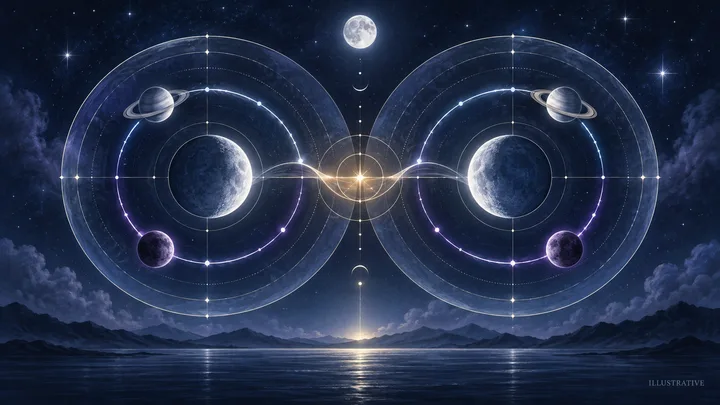
Synastry helps when it gives language to the pattern. Saturn may show where commitment and fear of restriction meet. Pluto may show where attachment becomes power. Venus may show what each person values and how affection is offered. The Moon can show what feels like home. Those layers become useful when they lead to a shared observation: ‘When I ask for certainty, you feel trapped. When you stay vague, I feel abandoned.’
That sentence can change a relationship because it replaces the courtroom with a map. It doesn’t decide who is right. It shows where each person stands. From there, a couple can make a small agreement. One weekly conversation. A deadline for a practical choice. A promise not to use breakup language during panic. A protected hour in which grief can be spoken without being turned into a plan.
Tenderness needs structure when the future is uncertain. Not a cage. A container. Without one, the more expressive partner carries the whole relationship while the quieter partner gets mistaken for stable. Silence isn’t always peace. Sometimes it’s simply unshared labor.
Mutuality also has a rhythm. One person may lead one conversation, while the other leads the next. One may have more capacity during a particular month. Equality doesn’t require identical energy at every moment. It requires that the imbalance be seen, discussed, and allowed to change. A temporary season of carrying can be loving. A permanent assignment is something else.
Watch the small follow-through. If one person says, ‘I’ll look into the housing options,’ do they return with what they found? If the other says, ‘I need you to meet my family before we decide,’ does that request enter the calendar? Affection is not only a feeling exchanged in private. It is also the way a person lets your reality alter their behavior.
A useful reflection report can place these themes side by side: emotional needs, commitment patterns, fear responses, ways of offering affection, and the parts of life that become shared. You can turn that map into a small participation ledger. Write down one thing each person is carrying, one thing each person is asking for, and one action each person will take before the next review. If only one column keeps filling, the problem isn’t a lack of intensity. It’s a lack of shared movement.
Sources: Synastry: Moon-Saturn Aspects; Synastry: Moon-Pluto Aspects Between Two Charts; Synastry: Love and Relationship Astrology
The strongest exception: some futures cannot be combined
Here is the exception that romantic language often avoids. Two people may love each other, repair well, and still want futures that cannot live under one roof. One wants children and the other doesn’t. One needs a religious life the other cannot share. One must care for family in a way that leaves no room for relocation. One needs a form of commitment the other cannot honestly offer.
A deep synastry pattern doesn’t cancel this. In fact, it may make the truth harder to accept because the relationship feels too significant to lose. You may think, ‘If this is rare, I have to make it work.’ But rarity isn’t the same as fit. A bond can be spiritually important and practically impossible. That doesn’t reduce its meaning. It tells you what kind of meaning it carries.
The key distinction is between a hard choice and a false choice. A hard choice asks both people to grieve and decide. A false choice asks one person to disappear so the relationship can continue unchanged. If staying requires you to abandon a central value, silence a necessary need, or accept a future you never chose, tenderness has already become self-erasure.
Astrology can help you bless the complexity. Saturn may show the seriousness of the promise. Pluto may show why release feels like death and rebirth. The eighth house may show the shared transformation. But no symbol should be used to shame a person for telling the truth about their life.
When the futures truly cannot combine, the loving act may be a clean grief rather than an endless negotiation. You can say, ‘What happened between us changed me. I still can’t build the life you need.’ That sentence hurts. It also stops the relationship from feeding on hope it cannot keep.
The exception protects the meaning of consent. A person cannot consent to a shared future by becoming exhausted enough to accept it. Nor can a person offer real commitment while secretly waiting for the other to change a central desire. The relationship needs more than love. It needs two unforced yeses.
Sometimes the incompatibility is not visible at the beginning because grief temporarily makes every choice feel provisional. Later, the truth becomes clearer. Don’t punish yourselves for not knowing sooner. People reveal their futures as they live through change. A promise made before the loss may have been sincere. It may no longer describe the life either person can lead.
If you do separate, resist the temptation to turn the ending into a verdict on the whole connection. A relationship can fail as a structure and succeed as an awakening. That isn’t a consolation prize. It may be the most accurate account of what the bond gave you.
Sources: Synastry: Moon-Pluto Aspects Between Two Charts; Eighth House in Astrology: House of Transformation
What repair looks like after the old future dies
Repair begins when both people stop trying to win the old future back. That doesn’t mean giving up quickly. It means admitting that the relationship has crossed a threshold. The question is no longer how to return to the version of you who made the first promise. It’s whether the people you are now can make a truer one.
Start with the facts. What changed? What did each person expect? Which expectation was spoken, and which one lived only in a private dream? What has the loss cost in time, money, identity, family closeness, health, or trust? Grief gets less frightening when it has nouns. ‘Our future changed’ is a beginning. ‘We no longer agree about where we’ll live, who we’ll care for, or whether we’ll have children’ gives the conversation a floor.
Then separate witness from action. The first person may need to be heard before they can decide. The second may need a boundary before they can stay present. Offer both. ‘I’ll listen tonight without fixing this. Tomorrow we’ll decide whether we need a plan.’ Or, ‘I can talk about the move for an hour, but I can’t promise an answer before I’ve slept.’ A boundary can be tender when it protects the conversation instead of ending it.
Bring the chart in after the lived pattern is visible. State the inputs and scope precisely if you’re working with a synastry report: whose Moon, whose Saturn, which aspect, what orb, and whether birth times are reliable enough for house overlays. Then let the symbolism sharpen the reflection. Don’t use it to prosecute the other person. ‘This Moon-Saturn contact may explain why care feels like duty between us’ is useful. ‘Your Saturn proves you’re blocking my destiny’ is not.
A new future doesn’t need to feel as certain as the old one did. It needs to be chosen in daylight. That’s how tenderness returns.
Repair also includes the right to revisit an agreement. Grief is not a one-time event, and a plan that feels generous in March may feel impossible in November. Set a review point before you make the first commitment. That keeps revision from feeling like betrayal. It says, ‘We’re choosing this honestly with what we know, and we’ll keep meeting the truth as it changes.’
Make the review specific. Choose a date, name the question you’ll revisit, and decide what information each person will bring. If you’re trying a temporary move, discuss the cost, the length of the trial, the contact you’ll keep with family, and the sign that the arrangement is harming one of you. A review isn’t a hidden breakup deadline. It’s a promise to stay awake inside the promise you’ve made.
Make the agreement concrete enough to protect both people. Decide what support means. Decide which family responsibilities are shared and which remain personal. Decide how much uncertainty you can carry without calling it freedom. Decide what happens when one person needs to pause. Tenderness grows around clear edges because each person knows where care ends and coercion would begin.
And give the relationship pleasure again. Grief can make every conversation a summit meeting. Cook something simple. Take a walk without solving the future. Laugh without apologizing. A bond needs serious honesty, but it also needs moments that are not evidence of anything.
Sources: Synastry: Moon-Saturn Aspects; Synastry: Moon-Pluto Aspects Between Two Charts; Synastry: Love and Relationship Astrology; Eighth House in Astrology: House of Transformation
The conversation that tells you whether tenderness can last
Don’t begin with, ‘Are we meant to be?’ That question is too large for a grieving heart. It invites a dramatic answer and hides the practical one. Begin with a smaller, braver question: ‘What future are you grieving, and what future can you honestly imagine now?’
Ask it when neither person is rushing out the door. Let the first answer be incomplete. Grief rarely speaks in a tidy paragraph. One of you may cry. The other may go quiet. Stay with the difference long enough to learn whether quiet becomes presence or escape.
Then ask three follow-ups. ‘What part of your old future can’t you give up?’ ‘What would you need from me to try a shared future without betraying yourself?’ ‘What are you willing to do in the next month that would show this is mutual?’ These questions move from memory to value to action. They make tenderness observable.
Listen for a real answer, not the answer that keeps the evening calm. A real answer may be uncertain but specific. ‘I don’t know if I can move, but I’ll research a six-month option and speak with my family.’ ‘I want children, and I won’t pretend that desire will fade so we can avoid pain.’ ‘I need space, but I’ll call on Sunday because I don’t want space to become disappearance.’
The test is whether both people can bring an extraordinary feeling into an ordinary promise and keep it. Tenderness has room for truth, limits, repair, and a future neither person has to fake.
You may not get an answer in one conversation. You can still get information. Did the other person stay present when the answer became inconvenient? Did they ask questions, or only defend their preferred future? Did they offer a next step without demanding instant certainty? Did you tell the truth, or did you soften it until it became impossible to understand? These are not small details. They are the relationship speaking.
If the conversation goes badly, that doesn’t automatically settle the future. Grief makes people clumsy. Try again when the nervous system has quieted and the facts are clearer. But notice the difference between clumsy repair and repeated refusal. A hard talk can be survivable. A pattern in which only one person returns to the table will eventually teach you the answer.
Ask the question, then watch what follows. Meaning lives in the feeling. The future shows itself in the response.
You can write the question down before you speak. That helps when fear turns every sentence into a defense. Write two columns: the future I’m grieving, and the future I might choose. Then ask the other person to do the same. Read the lists slowly. You’re not looking for identical answers. You’re looking for places where care, timing, and willingness can meet.
If you find a point of meeting, protect it with a small promise. Put the date on the calendar. Tell one trusted person. Return to the conversation after the first burst of relief has passed. If you find no point of meeting, let that knowledge be clean. A tender ending is still an ending, and naming it may be the first way both people stop grieving alone.
The future doesn’t have to resemble the dream that brought you together. It does have to be real enough for both of you to enter. That’s the quiet measure of a lasting bond: not perfect agreement, but two people able to stand in the truth without asking the other to become smaller, quieter, easier, or less alive. That kind of love can grieve honestly and still leave the door open for a life that belongs to both of you.
Sources: Synastry: Moon-Saturn Aspects; Synastry: Moon-Pluto Aspects Between Two Charts; Synastry: Love and Relationship Astrology
A little more clarity
Can a soulmate connection survive when two people want different futures?
It can, if the difference is negotiable and both people keep participating. A powerful synastry pattern may explain recognition, loyalty, fear of loss, or the sense that the relationship changed you. It can’t make incompatible values compatible. Talk about the exact future each person wants, the limits neither person can cross, and the next action each person is willing to take. If one partner must erase a central need, the relationship may remain meaningful without remaining a shared life.
What synastry placements can describe grief and deep emotional change?
Astrologers often examine Moon contacts with Saturn or Pluto, Venus contacts with Saturn or Pluto, and strong eighth-house themes. Moon-Saturn can describe emotional seriousness, duty, and the need to avoid shutting down feelings. Moon-Pluto can describe intensity, fear of loss, and deep transformation. The eighth house adds intimacy, shared resources, vulnerability, endings, and renewal. Read these symbols together with the lived relationship. They describe a field of experience, not an inevitable outcome.
Sources & further reading
- Synastry: Moon-Saturn Aspects
Supports the reading of Moon-Saturn as serious, dependable, potentially long-lasting, and vulnerable to emotional censorship.
- Synastry: Moon-Pluto Aspects Between Two Charts
Supports the reading of Moon-Pluto as emotionally powerful, transformative, and capable of activating fear of loss, jealousy, or control.
- Synastry: Love and Relationship Astrology
Supports the broader interpretive roles of Venus, Jupiter, Saturn, Pluto, and interchart contacts in relationship astrology.
- Eighth House in Astrology: House of Transformation
Supports the eighth house themes of intimacy, shared resources, mortality, loss, vulnerability, and transformation.
Complete Connection Meaning Report
Eighteen private reflections become a complete 12-section reading of recognition, mutuality, repair and your possible future.
Explore my connection