
Two people protect a meaningful connection by treating independence as part of the bond, not as a threat to it. Keep a private life, a shared rhythm, and a clear way to return after time apart. In astrological terms, this is the meeting point between Venus, which draws people toward pleasure and affection, Saturn, which asks for responsibility, and Uranus, which needs room for authenticity and change. The lasting choice is not unlimited distance or total fusion. It is mutual participation: each person keeps friends, work, interests, and inner space, while both people show up for the promises they make. A chart can describe why closeness feels familiar, intense, or difficult. It cannot replace the daily evidence. Look for curiosity, fair agreements, and repair after a missed expectation. Those are the signs that the connection has a future worth building.
The connection lasts when space becomes part of the promise
A meaningful connection can feel like a home you found before you knew you were looking for one. You recognize the person's humor. You trust the quiet between conversations. You may even feel that the bond has its own weather, its own language, its own pull. Then ordinary life enters. A friend needs you. Work expands. One of you wants a weekend alone. The other hears rejection where you meant restoration.
The question is not whether two people need space. They do. The real question is whether space has a place inside the relationship, or whether every separate choice becomes evidence against it.
My strongest answer is this: protect the connection by making independence visible, mutual, and predictable. Keep your own friendships. Keep interests the other person doesn't share. Name the times you need quiet before you disappear into it. Then return when you said you would. Love doesn't grow by making two lives identical. It grows when two people can leave the room without leaving the bond behind.
That distinction matters because intensity can imitate intimacy. A couple may spend every spare hour together and still avoid the harder work of knowing each other. They may call constant contact devotion when it is really fear. Another couple may see each other less often and carry a deeper sense of trust because neither person has to perform closeness every minute.
Astrology gives this problem a language. Venus describes attraction, pleasure, affection, and the way love wants to move. Saturn asks what can be sustained, what responsibility feels like, and where fear turns a promise into a rule. Uranus brings difference, freedom, surprise, and the need to remain authentic inside a bond. None of these symbols wins by itself. A connection needs all three. Warmth without structure fades. Structure without air hardens. Freedom without participation becomes distance.
So begin with the agreement underneath the schedule. Can I be fully myself here? Can you? Can we make room for each other's lives without treating that room as a verdict? If the answer is yes, separate lives won't weaken the connection. They'll give it somewhere to breathe.
Sources: Synastry | Cafe Astrology; Synastry: Venus-Saturn Aspects Between Two Charts | Cafe Astrology; Synastry: Venus-Uranus Aspects Between Two Charts | Cafe Astrology
What astrology can show about closeness and autonomy
A synastry reading compares two birth charts by sign, house, and aspect. It doesn't reduce a relationship to one sign pair or one dramatic contact. It looks at how the planets in one chart meet the planets and angles in the other, then reads the pattern as a conversation between needs. That matters here because the wish to be close and the wish to remain distinct rarely belong to one symbol.
Venus is a natural starting point. In relationship astrology, Venus speaks to attraction, pleasure, affection, values, and the ways two people offer warmth. A Venus-Moon contact can feel familiar and tender. Venus-Venus contacts can show shared tastes and a similar style of giving love. Venus-Mercury can make conversation itself pleasurable. These patterns help explain why a connection feels easy to return to, even after a disagreement.
But Venus alone doesn't tell you how the bond handles time, pressure, or difference. Saturn adds the question of durability. It can describe a person who takes the connection seriously, or a relationship that teaches patience and accountability. It can also show where one person feels watched, corrected, or held to an old version of themselves. A Saturn contact may bind two people together, but binding is not the same as nourishing.
Uranus brings the missing question: can love make room for an individual life? In Venus-Uranus synastry, the attraction may be immediate, unusual, and difficult to keep inside a standard relationship script. The freedom isn't a decorative extra. It is part of what lets the affection stay alive. Some couples travel independently, protect separate rooms for work, or keep strong friendships outside the partnership. The form matters less than the agreement. If both people understand the shape of the bond, difference can become loyalty to what is real rather than a threat to what is familiar.
Read a chart as a pattern of needs and responses, not a sentence handed down about the future. A person with strong Saturn themes isn't doomed to control. A person with Uranian themes isn't destined to leave. A Venus-Mars contact can describe desire without promising emotional safety. Read the pattern in three passes: what draws you together, what strains the bond, and what helps both people return to one another. The chart shows the pressure points. The people decide whether those pressures become habits, conversations, or repairs.
A useful reading also separates natal tendency from the relationship's current season. One person's natal Venus may need steady reassurance, while a current work or family pressure makes daily contact harder. A synastry contact may describe the bond's charge, but the present circumstances decide how that charge gets expressed. Ask two questions at once: what does this connection awaken in each person, and what conditions would let that awakening become generous rather than demanding?
You can make the answer concrete by comparing three layers. The first is attraction: what draws you back and makes the connection feel special. The second is capacity: how much time, attention, and emotional energy each person can actually offer. The third is consent: whether both people have chosen the same kind of bond. A chart may illuminate the first layer. Conversation and behavior reveal the other two.
If you have birth data for both people, a serious comparison needs the exact inputs used: date, local birth time when available, birth place, zodiac system, house system, aspect list, and orb policy. Without a reliable birth time, houses and angles become less secure. This article makes no personal chart calculation. It offers the interpretive map. Your lived pattern decides which part of the map matters most.
Sources: Synastry | Cafe Astrology; Synastry: Venus-Saturn Aspects Between Two Charts | Cafe Astrology; Synastry: Venus-Uranus Aspects Between Two Charts | Cafe Astrology
First, protect the two lives that existed before the bond
A connection becomes safer when neither person has to become smaller to prove love. That sounds obvious until closeness starts to reorganize the week. Friends receive fewer replies. A private hobby disappears. Rest becomes something you take only when the other person is busy. Soon the relationship carries every need: companionship, praise, entertainment, comfort, identity, and proof that you matter. That is too much weight for any bond.
Protecting separate lives doesn't mean keeping one foot out of the relationship. It means remembering that a partner cannot be your entire world without the world becoming narrow. A full life gives you stories to bring home, skills to share, and a self that remains alive between meetings. It also gives the other person the dignity of choosing you rather than managing you.
Start with the practical pieces. Keep at least one friendship that belongs to you as an individual. Keep one activity that restores you without requiring your partner's interest. Protect your work or study hours. Let each person have a room, ritual, or stretch of the day that doesn't need explanation. If you share a home, privacy becomes even more important. A closed door should not automatically mean a closed heart.
Astrologically, this is where the Sun and the first house matter as much as Venus. The Sun describes the life force that wants to shine in its own form. The first house speaks to embodiment, instinct, and the way a person enters life. In synastry, strong personal-planet contacts can make a partner feel central. That can be beautiful. It can also tempt one person to orbit the other until desire replaces identity.
The eleventh-house layer adds another clue. It belongs to friendship, groups, hopes, and the wider social field in which a person feels connected. A relationship that honors the eleventh house allows each person to keep a community and a future that isn't contained by the couple. That doesn't make the partnership less intimate. It keeps intimacy from becoming a locked room.
Imagine Maria and Luca, who love their evenings together but notice that Maria has stopped seeing her sister and Luca no longer plays music with friends. They don't need a grand rescue. They need a visible reset. Maria schedules one evening with her sister. Luca returns to rehearsal. They keep two nights for the relationship and leave one night open. At first, the empty space feels strange. Then their conversations improve because each person has returned with something of their own.
The test is mutuality. If one person gets freedom and the other carries all the domestic or emotional work, the arrangement isn't spacious. It's unequal. Separate lives only protect a connection when both people receive time, care, and room to develop.
Notice the difference between a protected life and a hidden life. A protected life has shape. You can describe the people, work, interests, or quiet that matter to you. Your partner may not share them, but they know they exist and don't have to compete with a mystery. A hidden life depends on missing information, shifting explanations, or a rule that says questions are disloyal. Privacy lets a person remain an individual. Secrecy prevents the other person from making an informed choice.
Before you call the arrangement balanced, look at one ordinary week. Who received care? Who had uninterrupted time? Which friendships stayed visible? Which plans did one person cancel more often? You don't need a score. You need the pattern. If one person repeatedly takes the flexible role, the relationship is not protecting separate lives. It is assigning one person the job of absorbing every change.
The aim is not perfect symmetry every day. A new parent, an illness, an exam, or a demanding season can make the exchange uneven for a while. Mutuality means both people can name the imbalance, understand its reason, and trust that the arrangement will be revisited. Temporary sacrifice feels different from permanent disappearance.

Sources: Synastry | Cafe Astrology; Synastry: Venus-Saturn Aspects Between Two Charts | Cafe Astrology
Then separate intensity from mutual participation
A powerful feeling deserves respect. It doesn't deserve automatic authority. You can feel recognized by someone and still not know whether the relationship can hold ordinary life. You can think about a person constantly and still be the only one making plans. You can experience a soul-deep familiarity while the other person avoids clear choices. Meaning and mutuality are related, but they aren't the same thing.
This is the point where many people misuse astrology. They find a compelling Venus-Pluto, Moon-Neptune, nodal, or Saturn contact and treat the symbol as proof that the bond must be preserved at any cost. But an intense chart can describe intensity. It cannot perform reciprocity for two people who won't practice it.
Look for the less cinematic evidence. Does the person ask about your inner life and remember the answer? Do they make room for your plans, not only their own? Can they tolerate a boundary without turning cold? When they disappoint you, do they help repair the effect, or do they defend the intention and leave you holding the hurt? These questions carry more weight than the rush of recognition because they show participation over time.
The astrological distinction is useful. Neptune can speak to longing, imagination, spiritual feeling, and the image of what love might become. Pluto can bring depth, compulsion, transformation, and the feeling that nothing superficial will satisfy. These are important experiences. They can open a door. They can also make a person fill in missing facts with hope. Venus-Moon contacts may create familiarity, while Venus-Saturn can add weight and staying power. Still, the chart needs to meet a person who can act with care.
Consider an example. Elena and Noor meet during a difficult season and recognize each other's grief. The bond feels immediate. Their conversations run late. They describe it as rare. But Noor keeps postponing every concrete plan, while Elena rearranges work and friendships to stay available. The feeling is real. The participation is not balanced. Elena doesn't have to insult the connection to stop carrying it alone. She can name what she wants, ask for a clear response, and treat the response as information.
A meaningful connection should survive a clear question. In fact, the question may be one of the ways it becomes real. Ask, 'What are we willing to make room for?' Ask, 'How will we know we're both choosing this?' Ask, 'What does care look like when one of us needs a life outside the relationship?' The answers will tell you whether the bond wants to become a shared life or remain a powerful possibility.
Intensity opens the story. Mutual participation determines whether the story can continue.
You can use a simple two-column test when the feeling is hard to judge. In one column, write what the connection evokes: recognition, longing, calm, desire, hope, or fear. In the other, write what the relationship actually does: plans, listens, keeps promises, makes repairs, includes your life, and handles a no. The first column matters. The second column decides whether the first column has a safe home.
This test matters even more when the connection began during a transition. The person who witnesses your change can feel fated. The meeting may be meaningful. Meaning still needs a form. If the relationship can hold the self that emerged, it may deepen. If it only wants the version of you from the first intense season, familiarity becomes a trap.
Astrology can name this as a tension between the natal story and the synastry story. Your natal chart describes patterns you carry into closeness. Synastry shows what the two patterns awaken together. Neither chart is a substitute for consent. A profound contact can reveal a lesson without requiring a lifelong partnership. Sometimes the lasting meaning of a connection is the way it teaches you to recognize what mutuality feels like.
Sources: Synastry | Cafe Astrology; Synastry: Venus-Saturn Aspects Between Two Charts | Cafe Astrology
Build a shared rhythm instead of demanding constant access
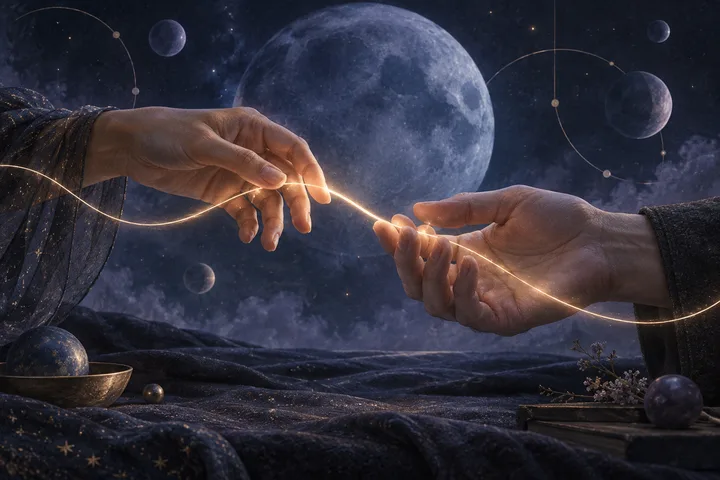
Separate lives need a shared rhythm. Without one, independence can feel like disappearance. With one, distance becomes part of the pattern rather than a surprise that keeps reopening the same wound.
A shared rhythm is not a rigid calendar. It is a set of promises that make closeness dependable. You might decide that one evening belongs to the relationship, that travel gets discussed before tickets are booked, and that a quiet day still includes a short message. You might agree that either person can ask for solitude without punishment, but the person asking will say when they expect to reconnect. The details differ. The principle stays steady: freedom needs clarity.
This is where Saturn serves the connection well. Saturn is often described as restriction, but its higher work is form. A container can protect what would otherwise spill away. A promise can make room for freedom because each person knows what remains secure. Cafe Astrology's Venus-Saturn reading names the danger too: commitment can slide into jealousy, criticism, or the loss of outside interests. The trouble begins when structure serves fear instead of trust. Then the schedule becomes surveillance.
Try a weekly conversation with three simple questions. What felt good between us this week? Where did we miss each other? What needs a small change before next week? Keep it short enough to use and honest enough to matter. A relationship doesn't need a summit meeting every time a feeling shifts. It needs a way to notice shifts before they become stories about abandonment or control.
Separate access from care. A partner may be unavailable during your workday and still care about what happens to you. They may spend an evening with friends and still keep an agreement to come home or check in. Privacy isn't secrecy. These distinctions stop every gap from becoming a mystery.
In a chart, Mercury deserves attention here because rhythm fails when people cannot name what they need. The Moon matters because a schedule lands in the body as safety or threat. Venus matters because the agreement should contain pleasure, not only duty. Saturn matters because follow-through turns a lovely intention into something you can trust. No single aspect replaces the conversation. It simply suggests where the conversation may need more care.
Imagine Maria and Luca again. Maria feels close when they talk every day. Luca feels close when they spend unhurried time together, even if they don't message much while working. Their old pattern turns this difference into a fight. Their new pattern gives it a shape: a good-morning message, two shared evenings, and no pressure to report every hour. Luca tells Maria when a work deadline will make him quiet. Maria tells Luca when she needs reassurance instead of pretending she is fine. The bond becomes less dramatic and more dependable.
That is the goal. Not maximum contact. Reliable return.
Make the rhythm visible enough that neither person has to guess. A shared calendar can help with travel, family obligations, and protected time, but language does the deeper work. Say, 'I want Saturday morning to myself, and I want us to have dinner together that night.' Or, 'I can listen for ten minutes now, or I can give you my full attention after work.' Specificity lowers the temperature because it replaces vague fear with a real choice.
Do not confuse a routine with a ritual. A routine keeps life moving. A ritual gives the bond meaning. It might be a walk after a hard week, a call before a long trip, or a quiet breakfast where neither person reaches for a screen. Small repeated acts make return feel real. They also prevent the relationship from depending only on peak experiences, dramatic reunions, or crisis conversations.
When a shared rhythm stops working, revise it before declaring the relationship broken. People change jobs, bodies, homes, families, and priorities. A promise made in one season may need a new shape in another. Saturn's wisdom is not stubbornly keeping an old form. It is taking the bond seriously enough to rebuild the form when reality asks for it.
Sources: Synastry | Cafe Astrology; Synastry: Venus-Saturn Aspects Between Two Charts | Cafe Astrology
Let difference stay alive without turning it into distance
Two people can love each other and want different amounts of togetherness. One may feel restored by company. The other may need solitude before affection feels available. One may build identity through community and work. The other may prefer a small private world. These differences don't have to disappear. They do have to become speakable.
The danger is not difference itself. It is the story each person tells about it. If you need space, your partner may hear, 'You don't matter.' If your partner wants more contact, you may hear, 'You are being controlled.' Sometimes those stories contain truth. Often they are old fears rushing to fill an unmarked gap.
Astrology can help you hold the distinction. Uranus describes a need for originality, movement, and freedom from dead forms. It doesn't excuse unreliability. Saturn describes responsibility and limits. It doesn't authorize possession. Venus wants connection and pleasure. It doesn't require self-erasure. When these principles work together, the relationship can make a new form that fits the people actually in it.
A Venus-Uranus theme may need more breathing room than a conventional relationship script allows. Separate travel, different hobbies, a friendship-first quality, or even separate work areas can support affection when both people choose the arrangement. But the strongest exception matters: space doesn't repair avoidance. If someone uses independence to dodge every difficult conversation, the problem isn't that the relationship is unconventional. The problem is that one person isn't participating.
A Saturn-heavy bond has the opposite risk. The couple may be loyal, dependable, and deeply attached, yet one person slowly edits out the parts of themselves that seem likely to attract criticism. The relationship looks stable from the outside. Inside, spontaneity has gone quiet. The repair is not to abandon commitment. It is to make growth part of the commitment. Ask what each person is becoming. Ask whether the bond can bless that change instead of treating it as betrayal.
Love protects freedom by staying interested in the person who is changing. That interest is not passive approval. It is an active willingness to meet the current version of the person you chose.
A good conversation about difference has three parts. Name the need without turning it into a character judgment. Describe the fear it awakens, without making the other person responsible for curing it. Then ask for an agreement that protects both sides. 'I need one evening alone' is clearer than 'You are crowding me.' 'I want more notice when plans change' is clearer than 'You don't care about me.' The first versions leave room for a response.
You can also ask whether a difference is fixed, seasonal, or negotiable. Someone may always need more solitude than you do. That may be a fixed difference. Someone may need extra quiet during a demanding month. That is seasonal. Someone may refuse every shared responsibility and call it freedom. That is not a preference to negotiate around. It is a choice with consequences.
The chart can make these distinctions more compassionate, but it shouldn't make them less precise. If Uranus describes a need for autonomy, ask what autonomy looks like in practice. If Saturn describes a need for commitment, ask which promises create safety and which rules create fear. If Venus describes different values, ask whether the difference is charming, painful, or both. Interpretation earns its place when it leads to a choice you can observe.
Sources: Synastry | Cafe Astrology; Synastry: Venus-Uranus Aspects Between Two Charts | Cafe Astrology
Use repair to turn separate lives into a shared future
Every relationship will fail a promise now and then. The meaningful question is what happens next. Does the person return to the conversation? Do they understand the effect, not only defend the intention? Do they change one behavior long enough for trust to register? Repair is where a connection stops being a beautiful feeling and becomes a way of living.
An apology is a sentence. Repair is a sequence. First, name what happened without softening it. Then acknowledge the effect. Next, say what you will do differently. Finally, do it when the next opportunity arrives. The other person may still need time. That doesn't make the repair a failure. Trust grows through repeated evidence, not one perfect exchange.
Astrologically, this is Saturn at its best. Saturn doesn't promise that two people will never hurt each other. It asks whether they can carry reality without turning away. In synastry, Saturn contacts may feel heavy because the bond touches responsibility, fear, and the pressure to remain. Their gift appears when both people use that weight to build something fair rather than to enforce sameness.
Moon contacts show why repair must include feeling. A person may understand the facts and still feel alone. Venus shows why tenderness matters after the explanation. Mercury helps the couple say the difficult thing without turning it into a trial. Mars tells you how conflict moves through the body: quickly, directly, defensively, or with a long delay before anger appears. Read the symbols together. Then watch the behavior.
Imagine Noor and Elena after the conversation about postponed plans. Noor admits that she enjoyed the closeness but kept avoiding commitment because she feared losing her independence. Elena admits that she responded by becoming endlessly available, hoping availability would create certainty. Neither confession erases the imbalance. It does make a new choice possible. Noor offers two concrete dates and keeps them. Elena stops rearranging her week around vague promises. They review the pattern after a month. The bond earns its next stage through action.
The strongest exception is a connection where repair never arrives. If every rupture ends with the same explanation, the same brief closeness, and the same return to the old behavior, intensity has become a reset button. Familiarity can feel spiritual because it repeats. Repetition alone is not growth. A relationship that asks you to forgive without changing the terms is asking you to carry the whole future. No Venus, Saturn, or Uranus contact can do that work for two people.
Protecting separate lives requires repair because freedom creates more chances for difference. You will miss a message. A trip will change. A new friendship will stir an old fear. The couple that lasts isn't the couple that avoids these moments. It is the couple that can meet them without making either person choose between truth and belonging.
Repair also needs a boundary around repetition. One missed promise calls for a conversation. The same missed promise after several conversations calls for a decision. You may change the agreement, reduce the responsibility you give the person, or decide that the bond cannot carry the future you want. This isn't punishment. It is the point where self-respect joins love. Without that point, forgiveness becomes permission for the pattern to continue.
Ask what evidence would make trust feel different. Maybe you need a plan made in advance, a message when circumstances change, or a real share of the work at home. Say the evidence plainly. Then give the other person a fair chance to offer it. Do not move the goalposts because you are afraid to believe them. Do not lower the goalposts because you are afraid to lose them. A clear standard protects both people from endless testing.
In astrological language, this is the constructive meeting of Saturn and Venus. Love remains warm, but it accepts form. The promise remains meaningful, but it becomes measurable in ordinary acts. That is not less romantic than a grand declaration. It is the part that lets the declaration survive Tuesday.

Sources: Synastry | Cafe Astrology; Synastry: Venus-Saturn Aspects Between Two Charts | Cafe Astrology
The decision is not fusion or distance, but a chosen way back
By now the question has changed. At first, it sounded like a scheduling problem: how much time should two people spend together? Underneath it was a question of meaning. If we need separate lives, does the connection still count? The answer is yes, but only when separation and return belong to the same honest pattern.
A lasting connection does not ask you to choose between your life and the relationship. It asks whether the relationship can join your life without taking it over. That means you need more than chemistry. You need agreements about time, friendship, money, home, work, family, privacy, and the future. You don't need every answer on the first day. You do need a willingness to keep answering as life changes.
The chart can help you notice the style of the tension. A Venus-Uranus emphasis may ask for an original relationship shape and strong respect for autonomy. Saturn may ask for patience, boundaries, and proof that freedom doesn't mean neglect. Moon and Venus can show how comfort and affection move between you. Mercury can show whether the two of you can make the invisible visible through language. That gives you a better question than 'Are we meant to be?' Ask, 'What must our arrangement protect so both people can stay honest?'
The decision test is simple enough to use tonight. When one person asks for space, can the other ask for clarity without demanding punishment? When one person wants more closeness, can the other respond without calling the need weak? When a promise breaks, can both people repair it? When one person grows, can the relationship make room for the new shape? If the answer keeps being yes in lived practice, the connection has something stronger than intensity. It has capacity.
The weaker alternative is to treat separate lives as evidence that the bond isn't deep enough, then chase reassurance through constant contact. That route may calm fear for a while. It also turns love into a test no one can pass. The other weaker alternative is to call every request for closeness a threat to independence. That protects the self by refusing the relationship. Neither extreme creates a shared future.
Choose the middle with conviction. Keep your people. Keep your work. Keep the part of you that changes in private. Then show the other person where you are going and make a real place for them there. A meaningful connection can hold two complete lives. It can even become more meaningful because neither person has to disappear to preserve it.
Start with one conversation: 'What part of your life do you need to protect, and what part of our connection do you want us to protect together?' Listen for a real answer. Offer one of your own. Then make one small agreement you can both keep this week.
If the answer feels too abstract, choose one area: friends, money, the home, or notice before a plan changes. The subject matters less than the method. One person speaks from experience. The other reflects what they heard. Both say what they can offer and what they cannot. Then test the agreement in real life instead of treating the conversation as a final verdict.
You can also ask what kind of future would make both lives larger. Perhaps you want a shared home with separate work areas. Perhaps you want a committed relationship with regular solo travel. Perhaps you want a partnership that keeps a strong friendship circle and protects evenings alone. There is no single correct shape. There is a correct question: does this shape let both people remain honest, cared for, and free to grow?
That is the earned conclusion. The connection can last, but not because a feeling has already guaranteed the future. It can last when two people keep choosing a form that protects recognition, participation, and repair. Let the astrology name the pattern. Let your agreements carry it.
Sources: Synastry | Cafe Astrology; Synastry: Venus-Saturn Aspects Between Two Charts | Cafe Astrology; Synastry: Venus-Uranus Aspects Between Two Charts | Cafe Astrology
A little more clarity
Can a strong soulmate-style connection survive when two people need lots of independence?
Yes, if independence is mutual and the relationship has a dependable way to reconnect. Astrology often frames this tension through Venus and Uranus: affection needs warmth, while Uranus needs authenticity and room to move. The important exception is avoidance. Separate lives can support love, but they can't replace clear choices, shared responsibility, or repair after disappointment. Watch what happens when one person asks for space. A healthy bond responds with clarity and respect. An unhealthy one uses space to disappear or uses closeness to control.
Which synastry patterns can describe a connection that feels close but still needs boundaries?
Venus-Moon contacts can describe familiarity, tenderness, and a strong wish to share daily life. Saturn contacts can add commitment, seriousness, and the need to work through fear or restriction. Venus-Uranus contacts can show attraction that needs freedom, freshness, and an unconventional shape. These patterns are interpretive clues, not guarantees. A proper synastry reading needs both birth charts, the zodiac and house methods used, and a consistent aspect policy. The lived test remains mutual participation, honest agreements, and the ability to repair.
Sources & further reading
- Synastry | Cafe Astrology
Supports reading synastry through Venus, Moon, Saturn, Uranus, aspects, signs, houses, and the wider relationship pattern rather than one isolated contact.
- Synastry: Venus-Saturn Aspects Between Two Charts | Cafe Astrology
Supports reading Venus-Saturn as commitment, loyalty, responsibility, and reliance, while also tracing jealousy, criticism, restriction, and withdrawal from outside interests as risks.
- Synastry: Venus-Uranus Aspects Between Two Charts | Cafe Astrology
Supports reading Venus-Uranus as sudden or electric attraction, unusual interests, creative expression, and a need for freedom, truth, and individual style.
Complete Connection Meaning Report
Eighteen private reflections become a complete 12-section reading of recognition, mutuality, repair and your possible future.
Explore my connection