
The connection can be real, and the test can still be a problem
You say you need a quiet evening. Your partner hears rejection. You ask to revisit a decision tomorrow. They hear a threat to the bond. You disagree about money, family, sex, or time, and suddenly the argument is no longer about the thing on the table. It becomes a referendum. Do you love me enough? Are we really meant to be? Would you choose me if this connection mattered as much as I think it does?
That shift can feel strangely familiar. The disagreement carries more heat than its subject deserves, yet it also seems to touch the heart of the relationship. This is where a soulmate feeling can confuse the reading. Recognition says, I know you. Intensity says, I can't stay untouched by you. Mutual participation says, we can meet each other in the ordinary work of being together. Those are related experiences. They aren't the same one.
My clearest answer is this: a meaningful connection that turns every disagreement into a test of love is not proving its depth. It is revealing the place where depth has become pressure. The bond may hold genuine recognition. It may carry powerful synastry. But its future depends on whether both people can stop using the relationship's meaning as evidence in every dispute.
Astrology gives us a strong language for this kind of knot. Synastry compares two natal charts and studies the aspects formed between their planets and angles. In traditional chart comparison, the planets describe the quality of the exchange, while the aspects show how the two lives connect. The chart can help you name why one person's Moon feels exposed by the other's Saturn, why Mars makes a small issue flare, or why Venus keeps looking for reassurance through closeness. It gives the pattern a shape.
But a shape is not a sentence. The chart doesn't say that one person must keep proving love, or that the other must accept the test. It shows where the exchange gathers force. Choice, maturity, timing, and practice decide how that force gets lived.
Consider an example. Lena and Tomas love the same late-night walks, remember small details about each other, and feel at home in silence. Yet when Lena asks Tomas to stop changing plans at the last minute, Tomas says she is making love conditional. When Tomas asks for one night alone, Lena says he is withdrawing from the relationship. Each request gets translated into a verdict about the bond. They aren't fighting about plans or solitude anymore. They're defending their right to feel secure.
The first reading is tempting: this must be a bond so powerful that every small event carries spiritual weight. The second reading is harder and more useful: the bond has made ordinary needs feel like threats. Both may be true. A connection can be unusually meaningful while its current way of handling difference remains unsustainable.
That distinction changes what you look for. Don't ask only whether the feeling is intense. Ask whether the relationship can survive a no without turning the no into a wound. Ask whether love remains visible when neither person is performing certainty. Ask what happens after the argument, when the beautiful language falls away and someone has to change a habit. That's where the answer starts.
Use the chart to separate the layers. Recognition belongs to familiarity. Tension belongs to the way certain planets meet. Endurance belongs to the structure two people build around those contacts. That separation is what keeps a soulmate reading useful.
Sources: Synastry: Love and Relationship Astrology; Synastry & Relationship Astrology
Before reading the chart, name the test in plain language
A chart can tempt you to begin with symbols. Start with the scene instead. What happens five minutes before the disagreement turns into a test of love? What exact sentence carries the accusation? What does each person do next? Does one person demand immediate reassurance, while the other goes quiet? Does one person threaten to leave, while the other overexplains? Does a boundary get treated as punishment? Does an apology arrive, but the same behavior return next week?
Write the pattern without astrology first. Keep it short. For example: When Maya asks for more notice before visits, Eli says she is keeping him at a distance. Maya then drops the request to prove she cares. Eli feels reassured for a day. The next surprise visit creates the same fight. That is not a soulmate verdict. It is a loop.
Naming the loop matters because it keeps the reading honest. A synastry chart is a comparison of two natal charts. It requires actual birth data for both people. If you have dates, times, and places, you can compare planetary positions and angles. If a birth time is uncertain, you can still discuss some planet-to-planet contacts, but you shouldn't treat house overlays or the Ascendant as settled. If the Moon changes signs near the birth time, even a Moon sign comparison may need care. The chart's inputs define the chart's scope.
Without both people's birth dates, times, and places, no personal positions or houses can be assigned here. The examples that follow are illustrative. They show how an astrologer might reason through a pattern while keeping the chart's scope honest. Precision gives spiritual meaning somewhere useful to land.
The most important question is not, Which aspect causes this? It is, What kind of contact would make this scene feel so charged, and what other layer would help it become livable? Cafe Astrology describes synastry as more than a Sun-sign match. Its overview places Venus with love and values, Mars with desire and assertion, and the chart comparison itself across planets, signs, houses, and aspects. Those roles give us a first vocabulary for the loop.
Try a three-line record after the next disagreement. First, write the visible request. I need one evening alone. I want us to decide by Friday. Please don't raise your voice. Second, write the hidden fear each person seems to hear. You don't love me. You're leaving me out. I don't matter. Third, write the action that followed. Reassurance, attack, silence, pursuit, withdrawal, repair, or nothing.
The hidden fear is often where the soulmate story takes over. A person may think, If this is the connection I believe it is, you should already know what I need. Another may think, If you loved me, you wouldn't need this boundary. Both thoughts turn intimacy into mind-reading and make a request feel like an exam with no questions on the page.
There is a quiet difference between reassurance and surrender. Reassurance answers the fear while leaving both people free. I love you, and I'll call tomorrow. Surrender asks someone to erase the need itself. I love you, so you can't go out, disagree, or ask me to wait. When a conflict becomes a test, listen for that difference. The first response builds trust. The second may calm the moment while making the next moment harder.
A spiritual bond doesn't remove the need for language. It makes language more important because the feeling carries so much authority. Say what happened. Say what you needed. Say what you feared it meant. Then separate the meaning from the demand. I felt lonely is different from You must prove that I'm your person. I need advance notice is different from If you loved me, you'd never surprise me.
This is also where you protect yourself from a common mistake in relationship astrology. You may find a compelling symbol and use it to explain away the scene. A Saturn contact becomes the reason someone withholds affection. A Pluto contact becomes a reason to excuse control. A Moon-Mars contact becomes a reason to call hurtful anger passion. Interpretive language should reveal the pattern. It shouldn't make the pattern untouchable.
Sources: Synastry & Relationship Astrology; Synastry - Skyscript Glossary
Read the Moon layer: is closeness allowed to include a separate need?
The Moon is the first layer to read when a disagreement feels like a threat to belonging. It speaks to comfort, instinct, emotional processing, and what helps a person feel safe. In synastry, one person's Moon meeting another person's personal planet can make the relationship feel immediate. The contact may explain the sense that you have known each other for years, or that the other person reaches a private room in you before you have chosen to open the door.
Cafe Astrology describes Sun-Moon contact as a meeting between outer expression and inner need. Its discussion of Moon-Venus contact points to familiarity, tenderness, and care, while also warning that charm can gloss over a problem instead of resolving it. These are important signatures of tenderness, but tenderness isn't the same as constant agreement. In fact, a strong lunar bond can make disagreement feel more personal because the relationship touches the nervous system before the mind has sorted the facts.
The question is simple and difficult: can the bond hold two inner worlds at once? If you need solitude, can your partner hear solitude as a real need instead of a withdrawal of love? If your partner needs more reassurance, can you respond without treating the request as weakness or manipulation? The Moon layer becomes healthy when safety grows large enough to include difference.
Imagine Maria and Noor. Maria's Moon is closely contacted by Noor's Saturn in their illustrative synastry. We aren't calculating their actual charts; we're using the contact as a teaching example. Maria may experience Noor as steady, serious, and capable of holding a long-term promise. She may also feel judged when her emotions arrive messily. Noor may believe responsibility means calming the situation, setting rules, or asking Maria to be more reasonable. Maria then feels shut out. Noor feels burdened. Both insist the other person's reaction proves something about love.
That contact can be read in at least two ways. In its mature form, Saturn gives the Moon a container. Noor follows through, keeps confidence, and stays present when Maria is upset. Maria trusts that Noor's steadiness isn't a refusal to feel. In its difficult form, Saturn becomes a gatekeeper. Noor decides which feelings are acceptable, while Maria has to become smaller to remain close. The same symbolic meeting can become shelter or pressure.
This is why a chart doesn't settle the question by naming a supposedly fated aspect. It asks you to watch the behavior that carries the aspect. When the Moon person says, I need comfort, does the Saturn person offer presence before advice? When the Saturn person says, I need a calmer conversation, does the Moon person respect the limit without calling it abandonment? Both people have work. The contact describes the meeting, not innocence and guilt in advance.
A disagreement becomes a test of love when one person's emotional need is made to stand for the whole relationship. The Moon layer helps you undo that inflation. A hard evening is a hard evening. It isn't proof that the bond is false. A request for space is a request for space. It isn't proof that the bond is ending. When you stop asking every moment to certify the connection, you give the connection room to breathe.
This layer also changes how you read silence. Silence can be a Moon need for time, a Saturn habit of containment, a Mars retreat before action, or a way to punish the other person. The symbol won't tell you which one is present by itself. Ask what the silence does. Does it create a clear return to the conversation, or does it leave the other person guessing until they chase? A pause with a promise can protect tenderness. A disappearance that demands pursuit turns tenderness into labor.
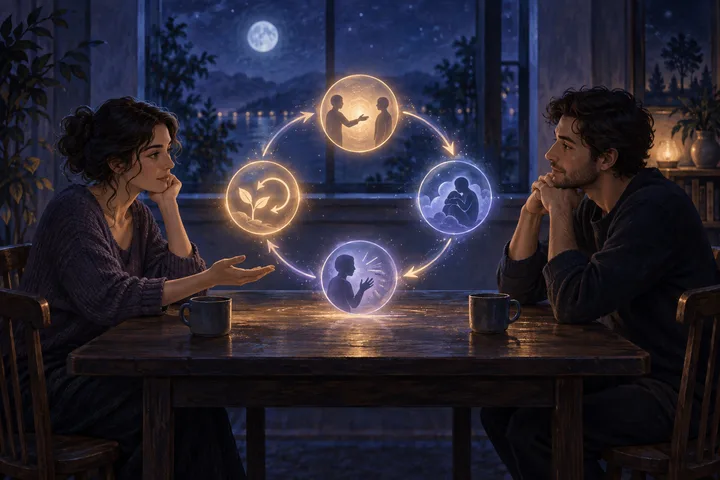
Look for three signs of a livable lunar pattern. First, the person who feels activated can name the feeling without making it a verdict. Second, the other person can respond without mocking, minimizing, or rushing to solve it. Third, both can return to the original issue after the emotional wave passes. If they can do that, the connection has a path through intensity. If they can't, the chart may explain the gravity, but the relationship is still asking for a new practice.
The strongest exception matters here. Sometimes a person uses the language of a Moon wound to demand access to everything: every thought, every hour, every private friendship. That isn't emotional safety. It's possession dressed as closeness. A soulmate feeling doesn't cancel the Moon's need for rest, privacy, and a body that can settle. Intimacy deepens when it leaves both people intact.
Sources: Synastry: Love and Relationship Astrology; Synastry & Relationship Astrology
Read Venus, Mars, and Saturn together instead of hunting for one answer
The next mistake is to search for a single aspect that explains the whole relationship. Synastry doesn't reward that shortcut. Read the roles together. Venus describes affection, attraction, values, and the ways love gets expressed. Mars brings desire, initiative, anger, heat, and the force that moves a conflict. Saturn brings limits, duty, time, and the structures that help a bond endure. A relationship that turns disagreements into tests often has a mismatch among these layers, not one magical culprit.
A Venus-Mars contact can make the bond vivid. Cafe Astrology links Venus-Mars contacts with romantic attraction, sexual magnetism, and friction, especially when the aspect is hard. That combination can make repair feel urgent and reunion feel intoxicating. It can also make conflict feel like proof that the connection is alive. The couple fights, then reconnects intensely. The relief gets mistaken for resolution.
Ask what happens in the quiet after the chemistry. Does Venus get to state a value without Mars treating it as a challenge? Can Mars express anger without making fear the other person's job? Can both people return to a practical agreement once the attraction has softened? A powerful Venus-Mars layer may explain why the two of you keep finding each other. It doesn't tell you whether you are learning how to disagree.
Saturn changes the question from How strong is the pull? to What can we carry? Cafe Astrology describes Saturn interaspects as a kind of glue that can bind people while remaining tricky to manage. That is the useful Saturn reading for this topic. Saturn is not a guarantee. It is the demand for form.
Imagine a couple with a strong Venus-Mars contact and a close Saturn contact to Mercury, the planet of speech and thought. Their conversations can feel charged. They may argue with precision, remember every word, and experience silence as a verdict. In the mature expression, Saturn helps them set a time to return to the issue, keep promises, and give hard truths a shape the other person can hear. In the shadow expression, Saturn turns the conversation into court. One person keeps the record. The other keeps trying to prove innocence.
This comparison gives you a practical ranking. Attraction explains why the bond is compelling. Emotion explains why the disagreement lands deeply. Structure explains whether the pair can build after the impact. If you have only the first two, you may have a relationship that feels unforgettable but keeps asking for the same emergency. If Saturn is present without warmth, you may have staying power without ease. What you need is not a perfect chart. You need enough warmth to return and enough structure to change.
Mars deserves special care because it can become the hero of a soulmate story. The fight feels honest. The anger feels cleansing. The reunion feels passionate. But anger can be direct without being cruel, and passion can be vivid without being destabilizing. The decisive question is whether Mars protects the bond's truth or protects a person's right to win. If the argument must end with one person surrendering, the connection has become a contest.
Venus adds another test. Can love survive a value difference? If one person wants public recognition and the other prefers privacy, the answer isn't hidden in the word soulmate. It lives in the agreement they make. If one wants frequent contact and the other wants wide independent space, affection alone won't settle it. Venus asks what each person values. Saturn asks what each person will consistently do. Mars asks how they behave when the answer frustrates them.
Mercury belongs in this group even when the argument seems emotional. The words used in conflict reveal whether the pair can translate feeling into a shared reality. You always, you never, and prove it turn a moment into a permanent identity. I felt alone when you changed the plan gives the other person something to answer. A chart contact involving Mercury may explain why speech cuts quickly or why conversation feels like the bond's main arena, but the practice remains the same: describe one event, one feeling, and one request before reaching for the history of the entire relationship.
Difficult aspects can create frustration, attraction, and growth at once. That is a better use of friction than romanticizing it. Friction can become a training ground. It becomes a trap when the relationship keeps paying the same cost without learning anything new.
Your chart reading should therefore end each aspect with a behavioral question. If this is Moon-Saturn, how do we make safety feel warm rather than supervised? If this is Venus-Mars, how do we separate desire from the need to win? If this is Saturn-Mercury, what rule protects a hard conversation from becoming a trial? The symbol opens the door. The answer waits in the practice.
If every disagreement becomes a test of love, the connection may be meaningful, but the pattern is asking for more than feeling. It is asking whether both people can stay present when they hear no, tolerate a separate need, and repair without demanding a dramatic proof of devotion. In astrology, a strong synastry contact can describe recognition, attraction, emotional gravity, or a binding sense of duty. It can show why a small disagreement feels charged. It cannot, by itself, make pressure into intimacy. Read the chart as a map of the meeting point, then watch what the two of you do there. A lasting bond will make room for boundaries, honest disagreement, and changed behavior after an apology. The next useful step is to name one recurring test, describe the need beneath it, and ask for one observable change. That is where the soulmate question becomes a relationship question.
Sources: Synastry: Love and Relationship Astrology; Synastry & Relationship Astrology; Synastry - Skyscript Glossary
The strongest exception: a recurring conflict can be a shared lesson, not a verdict
There is an important exception to the plain answer. Some disagreements really do return because the relationship is asking the same deep question from different angles. A couple may revisit money because trust and independence are still unresolved. They may revisit family because belonging and boundaries remain tender. They may revisit commitment because one person needs a plan while the other needs proof that a plan won't erase freedom. Repetition does not always mean the bond is failing. Sometimes it means the lesson has not yet become a habit.
Astrology gives this recurrence a meaningful frame. Difficult aspects may create tension, but they can also force attention and growth. Saturn can ask for responsibility. Mars can ask for directness. The Moon can ask for emotional honesty. Venus can ask whether the values underneath the romance actually meet. A compelling contact may keep bringing two people to the same doorway until they stop asking the doorway to prove that it is destiny and start walking through it together.
The difference between a shared lesson and a destructive loop is visible. In a shared lesson, the argument changes shape. The same subject returns, but the two people use better words, recover faster, and make more room for each other's truth. The repair gets more specific. The apology includes a new action. The original fear loses some of its power. In a destructive loop, the topic may change but the sequence stays fixed. Accusation, defense, escalation, promise, relief, repeat.
Consider an example. Sophie wants her partner to speak about their future. Daniel hears every question as pressure and says they should trust the feeling instead of defining it. Sophie then asks more urgently. Daniel withdraws. They reunite with tenderness, but no plan changes. Their connection may be sincere. Their timing may be complicated. The repeated test is still producing the same result: Sophie has no answer, and Daniel has no space that feels safe. Meaning has become a substitute for decision.
A chart can help them ask a better question. If their synastry emphasizes Saturn and the angles, they might explore duty, visibility, and the shape of commitment. If Venus and Uranus dominate, they might explore affection and freedom without turning either into betrayal. If Moon contacts carry the charge, they might focus on what reassurance actually calms the body. The chart doesn't choose the outcome. It helps them choose the conversation hiding underneath the argument: trust, freedom, reassurance, or a concrete promise.
The exception has a limit. A shared lesson requires two students. If only one person reflects, initiates repair, reads, apologizes, and changes, then the pattern is no longer a mutual spiritual task. It is one person's labor around another person's refusal. Astrology can show a bond that feels binding. It cannot make one-sided effort reciprocal.
Watch the next three repairs, not the next three declarations. After a conflict, does each person name their own part? Does the person who caused harm accept the effect without arguing about intent? Do they agree on a small change that can be seen? Does that change survive the next moment of stress? These are not cold tests that drain the romance from the bond. They are the way romance earns a place in ordinary life.
You can make that observation more exact by separating repair from reunion. Reunion is the warm moment when the two of you find each other again. Repair is what makes the next disagreement less damaging. A kiss may restore contact. A new agreement restores trust. Both matter, but they do different work. If the relationship offers reunion without repair, it may feel alive while the underlying injury grows. If it offers repair without any return of warmth, it may need a different conversation about desire and affection.
A real repair may sound plain. I raised my voice. That made you stop telling me what you needed. Next time, I'll take twenty minutes and come back by eight. Or: I treated your request for space as proof you were leaving. I won't ask you to cancel your evening to calm my fear. Please tell me when you'll reconnect, and I'll respect the time before then. There is no grand prophecy in these sentences. There is something better. They can be kept.
The strongest sign of a lasting connection is not that disagreement disappears. It's that disagreement stops needing a sacrifice. Neither person has to abandon a boundary to prove love. Neither person has to accept contempt to preserve the story. They can remain tender without becoming fused, and committed without becoming controlled. That is a spiritual achievement in its own right.
So if the same fight keeps returning, ask which part is actually repeating. Is the subject repeating, or is the fear repeating? Is the request unclear, or is it being punished? Is there a new agreement, or only a new promise? If the two of you can answer those questions together, the conflict may be carrying a lesson. If you cannot, its meaning is already clear enough: the relationship needs a boundary or a decision before it needs another interpretation.
Sources: Synastry & Relationship Astrology; Synastry - Skyscript Glossary
What to do with the reading: turn the soulmate question into a shared decision
A useful reading should leave you with a conversation you can have, not a label you can repeat. Begin with the recurring scene. Choose one disagreement, not the whole history. Describe what happened in order. Then name the interpretation that made the argument swell. I asked for time, and you heard rejection. You asked for reassurance, and I heard control. This sentence puts the meaning where it belongs: in the meeting between two experiences, not in one person's secret truth.
Next, bring in the chart layer only if it clarifies the question. If the available birth information supports it, compare the relevant planets and angles. Synastry normally uses the two natal charts side by side. Record the birth date, exact or approximate time, place, zodiac system, house system, aspect list, and orb policy used by the reading. Don't mix a precise aspect from one system with a broad sign-only impression from another and call the result one clear answer.
You don't need a catalogue of every contact. Start with the Moon for emotional safety, Venus for affection and values, Mars for desire and conflict, Mercury for language, and Saturn for commitment and structure. Read the natal charts first when the question is serious, then the synastry. A synastry contact can describe the space between two people, but each person brings a whole chart and a whole life to that space. The relationship cannot be reduced to the loudest aspect.
Then ask the same four questions of the chart and of the lived relationship. What draws us together? What gets activated when we differ? What helps us return? What structure would let this bond continue without either person disappearing? The first two questions describe recognition and intensity. The last two decide whether those qualities can become a shared future.
Make the next step small enough to keep. Agree on a pause phrase. Agree that a pause includes a return time. Ban the sentence that turns a boundary into a verdict. Replace Are you sure you love me? with What do you need from me right now? Replace If this is real, you'd know with Here's the part I haven't said clearly. These changes seem modest. They are not. They remove the courtroom from the middle of the relationship.
If your partner refuses every version of this conversation, take that refusal seriously. A connection can be spiritually important and still not be able to carry a partnership. The meaning may remain. The shared future may not. That isn't a failure of faith. It is a recognition that love needs participation, and participation has a shape: listening, choice, repair, and follow-through.
If your partner responds with curiosity, don't demand instant transformation. Watch for a pattern of effort. One good conversation can be sincere. A lasting relationship needs the next conversation, too. Saturn's lesson is time. Venus's lesson is value. Mars's lesson is how force gets used. The Moon's lesson is safety. Let each one become visible in a habit rather than a promise.
There is also a private decision for you. What are you willing to work on, and what are you no longer willing to call a test of love? Write both answers. The first protects devotion from becoming passive. The second protects devotion from becoming self-erasure. A soulmate tradition that honors the soul must also honor the life that soul is living, including sleep, friendship, work, privacy, and the right to disagree.
A shared future needs more than a shared explanation. It needs decisions about time, money, home, family, privacy, and the way conflict will be handled when both people are tired. These subjects can sound less luminous than recognition, yet they reveal whether recognition has become partnership. You don't have to make every decision at once. You do have to stop calling the absence of a decision proof that the bond is deeper than ordinary life. Ordinary life is where a lasting bond takes form.
This is the point at which an interpretation becomes a decision aid. If the reading shows a bond that is warm but easily threatened, build more reassurance without surrendering boundaries. If it shows strong attraction and weak follow-through, slow the reunion and strengthen the agreement. If it shows duty without tenderness, ask whether the structure still serves love. Different chart stories need different actions, but every sound reading returns you to the same measure: can both people participate in a life that feels larger, safer, and more truthful than the argument that brought them there?
Make the measure visible. After the next disagreement, write four lines: what happened, what each person feared it meant, what each person asked for, and what each person did afterward. A useful repair should answer the event, the fear, the request, and the action. If the answer skips the action, you have reconciliation language but no new pattern. If it skips the fear, you may have a rule that feels cold. If it skips the request, you are still asking the other person to read your mind.
The Connection Reflection Report can help you examine those layers in a focused way. Bring the question, the relationship context, and the chart details you actually have. The purpose isn't to hand you a soulmate score or predict a breakup. It's to give recognition, mutual participation, repair, and a shared future enough room to be seen separately. Then you can decide what the bond is asking of both people. Explore my connection when you're ready to turn that question into a focused reflection.
Return to the opening scene. Someone asks for space, and someone hears the end. Someone asks for reassurance, and someone hears a demand. The old reading says the intensity proves the love. The stronger reading says the intensity shows where love needs skill. If the two of you can build that skill together, the connection may last because it has become more than a feeling. It has become a way of treating each other.
Take one action today. Name the test without accusation, ask for one observable change, and set a time to see whether the change happens. Then watch. Not for another declaration. For participation here on earth.
Sources: Synastry: Love and Relationship Astrology; Synastry & Relationship Astrology; Synastry - Skyscript Glossary
A little more clarity
Does a soulmate connection turning disagreements into love tests mean the connection is false?
No. It means the connection may be carrying real recognition and an unhealthy conflict pattern at the same time. Astrology can help describe why a disagreement feels unusually charged through Moon, Venus, Mars, Mercury, Saturn, or angle contacts. The deciding evidence is mutual participation: can both people hear a boundary, repair after harm, and change a repeated behavior? If only one person keeps proving love while the other keeps demanding proof, the bond may be meaningful without being workable as a shared future.
Sources & further reading
- Synastry: Love and Relationship Astrology
Supports the relationship meanings used here for Moon, Venus, Mars, Sun-Moon, Moon-Venus, Venus-Mars, and Saturn contacts in synastry.
- Synastry & Relationship Astrology
Supports the use of chart factors and difficult interchart aspects to interpret attraction, friction, conflict, and growth.
- Synastry - Skyscript Glossary
Supports the traditional definition of synastry as chart comparison through planetary positions, angles, aspects, and planetary condition.
Complete Connection Meaning Report
Eighteen private reflections become a complete 12-section reading of recognition, mutuality, repair and your possible future.
Explore my connection