
The loneliness begins with a contradiction
You love each other. You may even have a private language, a history of returning to one another, and the strange ease of feeling recognized before either of you has finished a sentence. Yet something in the relationship stays unheld. You bring your fear, and your partner brings a solution. You ask for presence, and they offer loyalty.
A lonely soulmate connection isn't necessarily a loveless one. Recognition can be immediate. Mutual care takes repetition. Intensity can fill a room, while shared participation has to fill a calendar, a difficult conversation, a repair after disappointment, and the quiet decisions that make two lives fit together.
The common mistake is to treat being deeply seen as proof that the whole relationship is deep enough. A person can awaken your inner life without knowing how to meet it. A connection can carry memory, desire, spiritual meaning, or a sense of return and still leave one person doing most of the translating. That doesn't make the bond false. It makes the question more precise.
Synastry gives you a way to make that question precise. It compares two natal charts through the relationships between planets, angles, and, when birth times are reliable, house overlays. Skyscript describes it as chart comparison: aspects show the connection, while planetary condition describes the quality of the exchange. The useful question isn't only, Are we soulmates? It is, Which part of this connection is alive, which part is lonely, and can both people take part in making it livable?
This matters most in an established relationship, where love may have accumulated many forms of proof. You may have shared a home, supported each other's families, survived illness, or kept a promise through a hard year. Those facts deserve their weight. They still don't tell you whether the relationship has a place for your inner life today.
Sources: Synastry: The Astrology of Relationships, Episode 165 Transcript; Synastry, Skyscript Glossary
Before the chart, name the kind of loneliness
Begin with the room where you feel alone. This keeps the reading close to the life you are actually living.
Sometimes the loneliness is emotional. You tell your partner what hurts, but they stay outside the feeling. They may be kind, dependable, and proud to love you. Still, you don't feel accompanied while you're vulnerable. Sometimes it is conversational. You can talk for hours about ideas and plans, but direct questions about fear, resentment, or commitment turn into silence or debate. Sometimes it is structural. You share a home or a promise, yet one person makes the decisions and the other adapts.
There is also a loneliness of timing. One person wants to process now. The other needs days. One reaches for contact during stress. The other becomes useful, busy, or absent. Neither pattern proves a lack of love. It does show that love arrives through different doors. The problem grows when only one person learns how to walk through the other's door.
Consider this example. Elena and Tomas are affectionate and loyal. Tomas remembers important dates and never abandons Elena during a practical crisis. Elena still feels alone after conflict because Tomas repairs by fixing the task while she needs him to stay with the feeling. Their relationship has care. It lacks a shared method for emotional repair. The right question is whether Tomas can learn to offer presence, and whether Elena can ask for it in words he can hear.
Write down one recent scene, not a lifetime verdict. What did you ask for? What did the other person do? What did you carry afterward? Name the scene without accusation: When I asked for comfort after the family call, my partner gave advice and left the room. That sentence gives you something to read, and something the other person can answer.
Read the Moon layer for recognition and comfort
The Moon is the first place to look when a connection feels familiar. In relationship astrology, it describes emotional needs, habits, comfort, and the ways a person seeks safety when ordinary strength runs out. When one person's Moon connects with the other person's personal planets, the relationship can feel intimate before time and trust have fully earned that intimacy.
Moon-Moon contacts can create an instinctive sense that your inner weather makes sense to each other. A harmonious Sun-Moon contact can link one person's way of being with the other's emotional core. Moon-Venus contacts can feel especially gentle. Astrology.com describes the Moon as what we need for comfort and security and Venus as love and values. Together, they offer a clear astrological reason a bond can feel like home.
But home is not the same as company. A Moon contact may tell you why silence feels intimate, why a glance carries history, or why you recognize the other's vulnerability without an explanation. It doesn't promise that both people will speak when the relationship needs words.
Imagine Maria has a close Moon-Venus contact with her partner's chart. She feels cherished when they cook together, touch in passing, or remember the same small detail from years ago. Her partner feels that warmth too, but when Maria says she is frightened about their future, he changes the subject. The contact is real. It describes affection. The unanswered future question belongs to another layer of the reading.
Look at the condition of the Moon in each natal chart as well as the cross-chart contact. Is one person's Moon already carrying themes of withdrawal, duty, or fear? Does the other person's planet touch that sensitive place? The same contact can feel nurturing in one season and exposing in another. Read the Moon as the place where recognition begins, not as the final proof that you are emotionally met.

Sources: What Is a Synastry Chart? Birth Chart Compatibility; What's Your Sign? An Intro to Synastry Charts and Astrological Compatibility
Let Venus explain affection without making it the whole bond
Venus shows how love is expressed, received, enjoyed, and valued. In synastry, Venus contacts can make two people like one another with unusual ease. You may share taste, humor, tenderness, pleasure, or a sense that the other person brings beauty back into a difficult day. Venus can keep a relationship sweet while other layers are under strain.
That sweetness becomes confusing when the relationship asks for more than sweetness. One person may offer gifts, physical closeness, or a beautiful apology while avoiding the question that created the wound. Venus can smooth a surface. It cannot decide whose needs will shape the life underneath.
Intensity asks how strongly you feel; participation asks what you each do with what you feel. A strong Venus contact may answer the first question with a clear yes. The second appears in ordinary choices. Who initiates difficult talks? Who remembers the agreement? Who changes a habit? Who makes room for the other's joy without being managed into it?
Consider Noor and Adrian. Their Venus-Moon exchange is warm, and their social rhythm is easy. Their friends see the affection. Noor still carries the practical planning for their shared future. Adrian says he wants the same life, but he leaves every next step to Noor. The chart can describe attraction and tenderness accurately. It cannot turn a wish into a shared plan.
Read Venus against the values in both charts. If one person treats closeness as time together and the other treats it as freedom from pressure, neither is automatically less loving. They may need to translate love into forms the other can recognize. The important question is whether both are willing to translate.
A soulmate connection can feel lonely inside a loving relationship when recognition is strong but mutual participation is uneven. You may feel known in rare, beautiful moments, yet remain alone with the daily work of asking for comfort, naming hurt, or making a future real. Astrology helps separate those layers. In synastry, Moon contacts speak to emotional familiarity, Venus to affection and values, Mercury to the way you make contact, and Saturn to the duties and limits that give a bond staying power. A striking aspect can explain why the connection matters. It cannot replace a shared response. Start by comparing what you feel with what the relationship repeatedly does. Then read the chart for the pattern, not for a soulmate verdict. The most useful next step is one plain conversation about a specific need, followed by attention to whether both people act on what they heard.
Sources: What Is a Synastry Chart? Birth Chart Compatibility; What's Your Sign? An Intro to Synastry Charts and Astrological Compatibility
Bring Mercury into the room where the hurt happens
A relationship can feel spiritually known and verbally misunderstood. That combination creates a sharp loneliness because the good moments persuade you that communication should be easy. Sometimes the issue is simpler than the story you have built around it. Two people have different ways of thinking, asking, listening, and defending themselves.
Mercury describes the mind's movement and the way a person makes contact through words. Mercury contacts in synastry can show ease or friction in conversation, while each natal chart adds context. A supportive contact may help you name what the other person means before they finish. A tense contact may make a question sound like an accusation, or a pause feel like rejection.
The Astrology Podcast's discussion of relationship astrology puts communication among the central matters of a working partnership and recommends looking at both charts rather than isolating one contact. Moon and Venus can show why the bond feels good. Mercury shows whether the two inner worlds can become understandable to each other.
Try one concrete sentence: I need ten minutes tonight with no fixing, or I need us to choose a date for that conversation. Then watch the exchange. Does your partner ask what would help? Do they return after becoming defensive? Do they agree and forget? Do they reject the idea that your need deserves space? Those responses show the relationship's present language.
The standard isn't perfect fluency. It is repairable misunderstanding. A lively connection can contain different minds. If both people can slow down, clarify, and return, a difficult Mercury contact becomes material for growth. If one person keeps the door closed and asks the other to become more persuasive, the problem is no longer just a mismatch in style.
Sources: Synastry: The Astrology of Relationships, Episode 165 Transcript
Saturn shows why love can stay and still feel cold
Saturn is often blamed for the loneliness. That is too simple. Saturn can describe distance, restraint, fear, duty, unequal authority, or the feeling that tenderness must pass an exam before it enters the room. It can also describe endurance, responsibility, patience, and the structures that help love survive ordinary pressure. Saturn does both because commitment has weight.
When one person's Saturn contacts the other's Moon, the Moon person may feel managed, judged, or emotionally contained. The Saturn person may believe they are providing steadiness, boundaries, or protection. Both experiences can be true. The contact becomes lonely when one person's safety requires the other to become smaller. It becomes sustaining when responsibility moves both ways and restraint protects intimacy rather than replacing it.
Saturn-Venus contacts can carry the same tension. They may bind two people through loyalty and shared duty, yet make affection feel rationed or conditional. Astrology.com's synastry guidance treats Saturn as difficult but important because it can bring duty and the patience to endure hard seasons. The Astrology Podcast makes the point in a different way: Saturn appears often in long relationships because lasting bonds require people who are willing to keep working at them.
The strongest exception matters. A Saturn-heavy bond can become deeply sustaining when both people make warmth part of the structure. A weekly check-in, a fair division of care, a clear promise about how conflict ends, and room for pleasure can turn duty into shelter. Saturn asks what will still be true when the mood changes. The answer must include more than We are still together. It must include We still know how to reach each other.
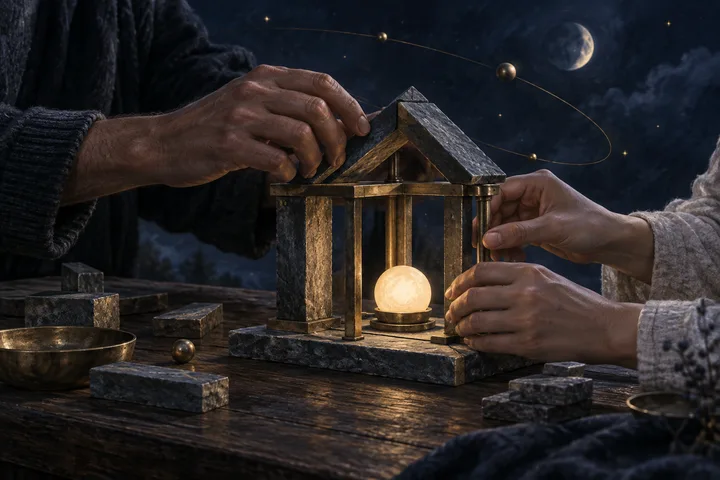
Read Saturn after the personal planets, not instead of them. First ask what the bond feels like. Then ask what it can carry. A relationship with recognition but no structure may drift. A relationship with structure but no emotional welcome may harden. Lasting love needs both a hearth and a frame.
Sources: What Is a Synastry Chart? Birth Chart Compatibility; What's Your Sign? An Intro to Synastry Charts and Astrological Compatibility; Synastry: The Astrology of Relationships, Episode 165 Transcript
A guided reading of the competing indications
This is a worked example, not a personal chart calculation. The names and placements are illustrative, and the point is the order of interpretation. A real reading would require both people's birth dates, birth locations, and exact birth times when houses and angles matter, followed by a consistent zodiac and aspect method.
Imagine Maria has a close Moon-Venus contact with Alex's chart. Their Suns also connect harmoniously, so Maria feels recognized by Alex's identity and Alex feels welcomed by Maria's emotional nature. This explains the beginning of the bond: familiarity, affection, and the sense that each person brings out something true in the other.
The next layer shows a tense Mercury contact. Maria asks questions by moving toward the feeling. Alex responds by defining the problem and proposing a fix. When Maria presses for reassurance, Alex hears criticism. When Alex offers a plan, Maria hears distance. Their affection is real, but their messages arrive in different shapes. Now the loneliness has a mechanism.
Then add Saturn. Alex's Saturn makes a hard contact to Maria's Moon. Alex takes responsibility for money, routines, and crises. Maria trusts that steadiness, yet often feels that her emotional needs are excessive or badly timed. Alex feels burdened by the expectation to provide comfort in a language he doesn't naturally speak. The same Saturn that keeps the partnership intact also creates the chill Maria is naming.
A shallow reading would choose one layer. It might say Moon-Venus proves soulmate tenderness, or Moon-Saturn proves emotional deprivation. The stronger reading holds the sequence. Recognition is present. Affection is present. Communication needs translation. Saturn supplies continuity but can restrict warmth. The bond can last, but it won't become less lonely through insight alone.
Read the charts both ways. Is Maria's Moon receiving most of the pressure while Alex's Saturn holds the authority? Does Maria's Mercury touch Alex's sensitive planet too? Does Alex have natal Saturn themes that make duty his safest form of love? Each answer changes the emphasis. Synastry is an exchange between two whole nativities, not a label assigned to one person.
If birth time is uncertain, keep the reading to what the inputs can support. Planet-to-planet contacts can be examined when the degrees are known, but house overlays and angles require more confidence in the time. Don't turn an uncertain house placement into a firm story about marriage, home, or public commitment. Precision makes the spiritual reading stronger because it tells you which part of the symbolism you are actually using.
Sources: What Is a Synastry Chart? Birth Chart Compatibility; Synastry: The Astrology of Relationships, Episode 165 Transcript; Synastry, Skyscript Glossary
The decision is whether loneliness can become shared work
A soulmate feeling deserves respect. So does the loneliness beside it. You don't have to choose between saying the connection is meaningful and admitting that it hurts. The admission may be the first honest act the bond has asked of you.
Start with one scene. Tell your partner what happened, what you felt, and what response would help next time. Keep the request small enough to observe: I need you to stay with me for ten minutes; I need us to return to this conversation tomorrow; I need us to make this decision together. A clear invitation gives love somewhere to land.
Watch the whole cycle, not just the first response. A partner may need time to understand, and that differs from refusal. Look for curiosity, ownership, and a visible attempt. If the attempt fails, look for repair. Does your partner name what went wrong, try again, and remember the request when the same pressure returns? Repair isn't one apology. It is a new pattern that survives the next ordinary inconvenience.
You can keep four short notes after an important exchange: what feeling came up, what words were used, what action followed, and whether the action held a week later. This isn't a way to turn love into bookkeeping. It keeps one beautiful conversation from carrying more weight than the pattern around it. If the notes show more listening, clearer requests, shared decisions, and reliable returns after conflict, difficult symbolism is becoming workable.
If the notes show repeated promises with no changed behavior, the loneliness isn't waiting for a better interpretation. It is describing the relationship as it is. A Saturn-heavy bond can still become shelter when its structure creates room for warmth, speech, and recovery. If the structure only preserves the home, promise, or arrangement, it is protecting the frame while the relationship goes unfed.
So why does a soulmate connection feel lonely inside an otherwise loving relationship? Because recognition, affection, attraction, and endurance aren't the same as mutual participation. Your chart may show why you find each other, why you stay, and where the bond asks to mature. Ask for one real change, observe the response and the follow-through, then decide whether this connection is becoming a home or asking you to carry its meaning alone.
Sources: What's Your Sign? An Intro to Synastry Charts and Astrological Compatibility; Synastry: The Astrology of Relationships, Episode 165 Transcript
A little more clarity
Can a soulmate connection be real if the relationship feels lonely?
Yes. A meaningful connection can contain genuine recognition and still lack enough emotional participation. Moon or Venus contacts may describe familiarity, affection, and comfort, while Mercury or Saturn tensions show why conversation, reassurance, or shared responsibility feels difficult. Read the feeling and the repeated behavior together. The bond is worth honoring, but its meaning doesn't require you to deny the loneliness.
Which synastry placements can explain loneliness in a loving relationship?
Look at the whole pattern rather than one placement. Moon-Saturn contacts can describe emotional restraint alongside loyalty and endurance. Difficult Mercury contacts can make two caring people miss each other's meaning. Venus may show affection that doesn't automatically become shared effort. Helpful Moon, Venus, Sun, and Saturn contacts can support closeness, but no aspect replaces honest communication, repair, and a future both people actively build.
Sources & further reading
- What Is a Synastry Chart? Birth Chart Compatibility
Supports synastry as layered charts and the Moon, Venus, Mercury, and Saturn themes used in the guided reading.
- What's Your Sign? An Intro to Synastry Charts and Astrological Compatibility
Supports emotional needs, love expression, communication, and Saturnian responsibility as distinct synastry layers.
- Synastry: The Astrology of Relationships, Episode 165 Transcript
Supports reading both whole natal charts, prioritizing communication, and treating Saturn as common in lasting relationships.
- Synastry, Skyscript Glossary
Supports the traditional definition of synastry as comparing nativities through aspects, angles, and planetary condition.
Complete Connection Meaning Report
Eighteen private reflections become a complete 12-section reading of recognition, mutuality, repair and your possible future.
Explore my connection